Margaret Street’s storyline mirrors the Norwegian fairytale “East of the Sun and West of the Moon.”
TO ANNOTATE, YOU’LL NEED 8 TABS OF THE SAME COLOR.
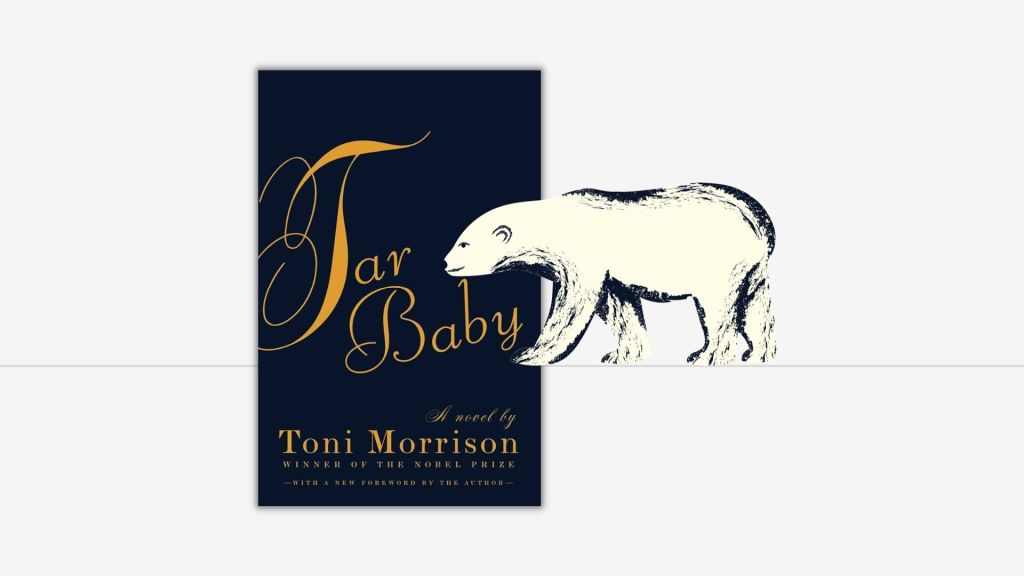
My literary hypothesis: Margaret’s storyline is an intentional retelling of a Norwegian fairy tale called East of the Sun and West of the Moon. It’s possible to draw plot parallels between Margaret’s character and the girl in the old tale.
An Overview of the Parallels between Tar Baby’s Margaret
- A child bride marries for wealth.
- The girl enjoys material wealth, but is incredibly lonely and isolated.
- The girl breaks a taboo. When her husband finds out, the fallout is dramatic.
- The girl doing laundry in the final scenes is an act of atonement.
The Polar Bear Bride In Both Stories
In “East of the Sun and West of the Moon,” the youngest daughter of a Norwegian family marries a polar bear. This is a financial marriage. The girl’s family is granted wealth.
At the bear’s castle, the girl has every material want satisfied, but has no contact with her husband during the day. At night, when he takes a human form, they can touch. No lamps are lit though. He forbids her to look at him. She grows lonely with this limited human contact.
One day, the girl acquires a candle. Desperate to see her husband’s face, she lights it one night and looks, immediately triggering a witch’s curse. Unbeknownst to her, her husband is a prince under a spell. When the candlelight reveals his face, he disappears “east of the sun and west of the moon.”
It takes the girl a long time to find her husband, the prince. Oddly, the only way to break the curse and set him free is to do his laundry. Once she washes away three drops of candle wax staining his shirt (these are drippings from the very candle she lit to see him), they can live happily ever after..
Source: Wikipedia
2 Quotes Link Margaret in Tar Baby to the Norwegian Fairy Tale
TO ANNOTATE—2 TABS NEEDED
The reference to the Norwegian tale in Tar Baby is very oblique. I discovered it because I had made a margin note next to the two times Valerian sees Margaret as a polar bear’s bride. This felt so strange. Why is she a polar bear’s bride in his eyes?
I had a hunch this turn of phrase was mythical.
A google search for “Polar Bear Bride Myth” quickly pulled up Norway’s “East of the Sun West of the Moon” fairy tale on Wikipedia. So many parallels with Margaret’s storyline jumped out at me reading this tale.
It also made perfect sense structurally and thematically for this fairy tale to be present in the text. Since Jadine’s and Son’s storyline sits under the umbrella of the Tar Baby tale, I wondered if Toni Morrison set up “East of the Sun West of the Moon to be the umbrella for Margaret’s and Valerian’s storylines.
Tab 1: Chapter 1, Page 16
“He saw the polar bear and then he saw her. The bear was standing on its hind feet, its front ones raised in benediction. A rosy-cheeked girl was holding on to one of the bear’s forefeet like a bride.”
– Toni Morrison, Tar Baby
Tab 2: Chapter 2, Page 54
“And the Bride of Polar Bear became his bride.”
– Toni Morrison, Tar Baby
5 Quotes Where Margaret’s Story Aligns with the Norwegian Fairy Tale
ANNOTATE THIS – 6 MORE TABS (OF THE SAME COLOR)
Like the fairytale girl, Margaret is a child bride.
Tab 3: Chapter 1, Page 26
“‘I was a child bride, remember?’”
– Toni Morrison, Tar Baby
There are many passages on Margaret’s loneliness and isolation. Here’s two.
Tab 4: Chapter 2, Page 56
“And they stepped back and let her be. They gave her care, but they withdrew attention.”
– Toni Morrison, Tar Baby
Tab 5: Chapter 2, Page 57
It was always like that: she was gone and other people were where they belonged.
– Toni Morrison, Tar Baby
Like the fairytale girl, Margaret is afraid of being sexually assaulted by an unseen stranger in her bedroom at night. In the book, we see this in her reaction to Son hiding in her closet, even though he had no intent whatsoever to harm her. But, the invisible ink here (a Toni Morrison phrase from The Source of Self Regard I love to think about by the way!) is that Margaret was once in the same position as the underage girl in the fairy tale. I wonder if Margaret really could consent to the marriage to Valerian and to her husband’s conjugal visits at night.
Tab 6: for the conversation in Chapter 6, Page 197
“You sat in my closet and scared the hell out of me.”
Tab 7: Beginning of Chapter 8
The taboo Margaret breaks is child abuse. I won’t get into the details here. I recommend tabbing the first page of Chapter 8, where Margaret begins telling Valerian the details of the abuse.
Tab 8: Chapter 10, Page 276-278
Jadine walks in on Margaret organizing Valerian’s wardrobe, getting ready to do laundry. This is odd atonement, delicately linked to the Norwegian fairy tale in two ways.
- A cursed character needs to hide in darkness: In the fairy tale, the prince is cursed to be in the dark. In Tar Baby, Valerian’s son and Valerian himself plays this role. Valerian repeatedly found his son Michael hiding in darkness “in the laundry under the sink, singing because he could not speak or cry” (Ch 8, page 234). He never investigated why his son was hiding. He knew but chose to keep himself in the dark about his wife’s abuse, never confronting her.
- Cleaning the husband’s clothes at the end: In the fairy tale, the girl cleans her husband’s shirt and frees them. In Tar Baby, the laundry room is a sinister touchstone in the family’s collective memory. It’s where Michael hid after he was abused. After Margaret is exposed, she turns to the laundry too. She cannot change the past, but she can focus on laundry as therapy. So, in keeping with the fairy tale, she starts organizing Valerians clothes.
“‘But what a mess. It’ll take days to get it all sorted.’”
– Toni Morrison, Tar Baby
 Annotate With Sara