
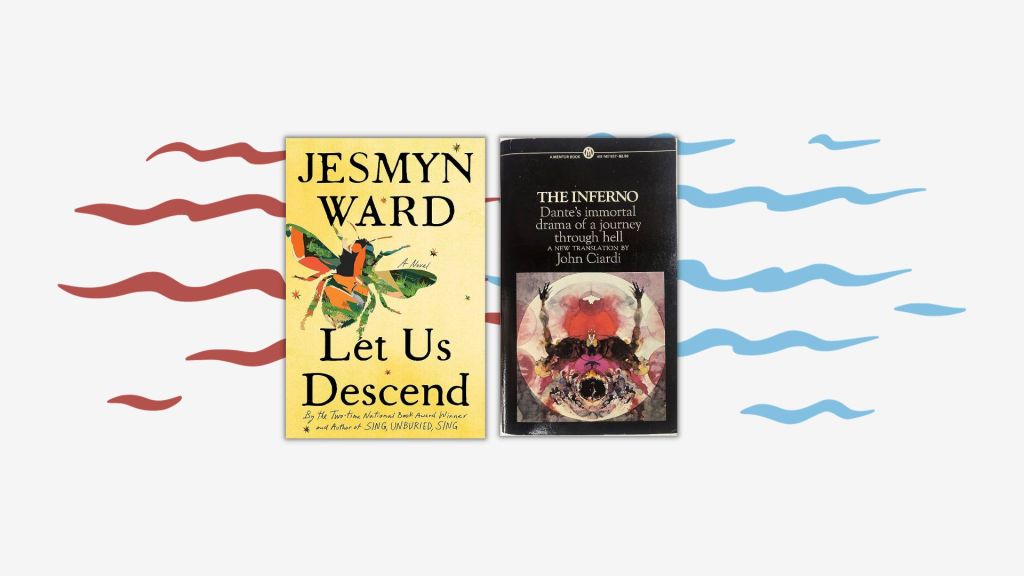
Let Us Descend by Jesmyn Ward is deeply in conversation with The Inferno by Dante Alighieri. On The Stacks Podcast, Jesmyn Ward revealed that Dante’s Inferno is indelible in her memory. When thinking about the hellish conditions of enslavement, especially for those forced to walk hundreds of miles to New Orleans slave markets, The Inferno naturally came to mind.
“I thought, what if Annis’s journey—because this is something of a descent into hell—what if it could reflect The Inferno? Or what if The Inferno could inform her descent into this hell?”
Jesmyn Ward on Ep. 292 of The Stacks Podcast (25:03).
Something That’s True
For both Annis and Dante, river crossings are harrowing, dreaded ordeals. They traverse hellish landscapes on foot, encountering many murky, deadly waterways. Neither Dante, nor Annis, have a choice: they have to make the dangerous water crossings, even when conditions are harsh.
A River Runs Through Them Both
This summer, in anticipation of Let Us Descend’s fall release, I read Dante’s Inferno for the first time in full. In college, in the early 2000s, I had read excerpts for a literature survey class, but never the whole thing.
One surprise for me was that Dante’s hell has a lot of rivers and a pretty complex watershed. I expected lots of fire and brimstone, not rivers of boiling blood and disgusting marshes. I did not expect water crossings to be some of the biggest challenges Dante faced on his journey.
Revisiting Dante’s Inferno prepped me, in many ways, for Annis’s dreadful rivers crossings in Chapter 4 of Let Us Descend. Because Annis’s descent into hell parallels Dante’s so much, it made sense that river crossings would be as bad for Annis as they were for Dante.
Fire and Ice Waterways
Rivers of Blood in Both Stories
River and blood imagery comes up right away in Let Us Descend, before the book even starts. The third epigraph is an excerpt from Jericho Brown’s poem “Langston Blue,” which you can read in full on poets.org.
Annis echoes the Jericho Brown poem in the first chapter. Touching her mother’s neck, she feels “the rush of blood there, the red river that binds her to me” (page 21).
Later, in Chapter 4, Annis imagines America’s rivers as blood veins on the land (page 70).
Dante’s bloody river, the Phlegethon, is pretty harrowing. It appears in Canto VII as a river of boiling blood that Dante and Virgil cross riding on a centaur’s back.
Frozen Rivers in Both Stories
In Chapter 4, Annis breaks through the veil that separates her world and the spirit world. Unbound and crossing the widest river yet on a skiff, she hears the voice of the old river spirit. Not fully understanding its language, she parses out the words “cold” and “ice” and “rest.” I wondered if Jesmyn Ward was evoking the cold iced-over Cocytus river in Dante’s Inferno. Violent souls and Satan himself are stuck in the ice, motionless and leering—kind of like the alligators Annis notices as she crosses (page 84).
 Annotate With Sara