
Strawberry imagery is a staple ingredient in Land of Milk and Honey by C Pam Zhang, a food-filled, dystopian novel about a private chef who cooks for the ultra-rich during an apocalypse-like climate change event.
The unnamed narrator works at the very last place with unadulterated sunlight on earth: a high-security mountaintop facility in Italy. It’s the land of milk and honey because it is above the smog layer that smothers the rest of the world.
The Significance of Strawberries
Page one gave an early clue that strawberry imagery would be important to the story. Of all the foods the narrator missed, she specifically lamented the loss strawberries. Strawberries will come up over a dozen times after this first moment.
For the narrator, strawberries trigger nostalgia, represent ephemerality, symbolize gluttony and rot, and are likened to the human heart.
The narrator grew up near Southern California strawberry fields, eating the first berries of the season, picking them with her mother, and watching the unpicked rot in blood-like puddles in the fields. From these early memories, strawberries take root in her mind as symbols of life’s precious, abundant, and short-lived passions. They also become symbols of waste and overconsumption.
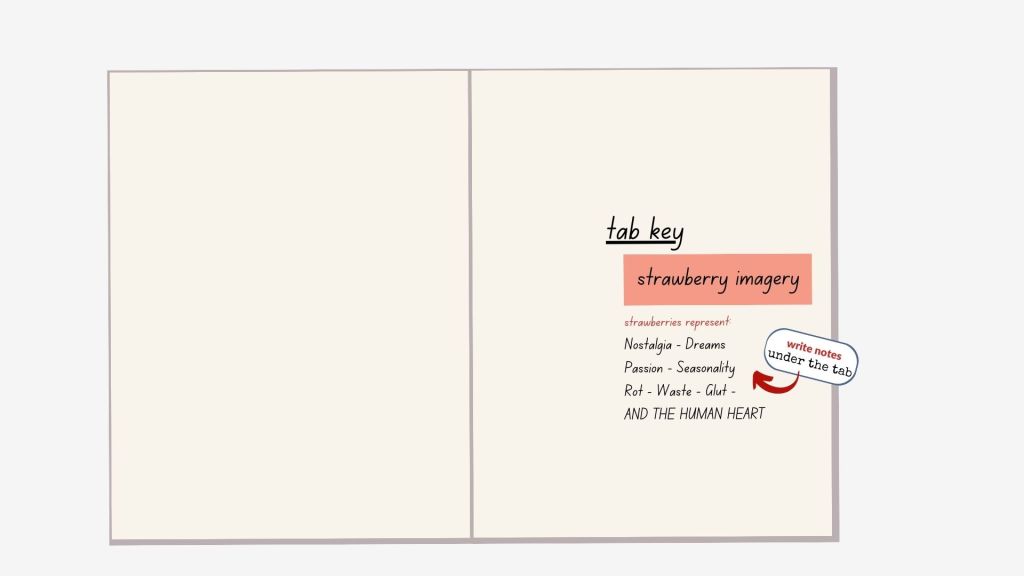
Strawberry Annotating Guide
You will need 12 tabs of the same color: 11 to mark the book’s primary strawberry quotes + 1 extra for the tab key.
Tab 1 is for the tab key!
Place a tab on a blank page in the beginning of the book. Label it strawberry imagery. Make some notes from this post like the ones in the photo above.
Tab 2: Ch 1 p 3
“I hadn’t seen California in ten years, hadn’t tasted a strawberry or a leaf of lettuce in three.”
Tab 3: Ch 1 p 4
“No avocados, no strawberries, no almonds. California had become a food desert and I imagined wind howling through broken windows, scouring, dry, unclean.”
Tab 4: Ch 1 p 10
“…and then I was no longer thinking because at the bottom of the box I touched something as warm as skin, as yielding as a woman’s inner thigh: strawberries.”
“Red: that color of desire.”
Tab 5: Ch 1 p 11
“He never stored a strawberry cold. Close to the stem, he said, closest to the earth, their perfume is complex, not sugar: closer to flesh, the flesh of a loved one, not sanitized, not anodyne, but full of many waters. Strawberries and spring, strawberries and musk, strawberries and sex flooded back as I crushed my tongue to sugar.”
Tab 6: Ch 1 p 13
“For the second time, I tasted strawberries.”
“In Pasaje, California, my mother and I lived by fields of lettuce and strawberries and almonds that fed the dream.”
“In picking season we ate for weeks like the wealthy, bushel after bushel of prime fruit. It was economical. Strawberries and syrup, strawberries and rice, strawberries in vinegar and chilies and oil, as juice as mash as soup, strawberries eaten to excess…”
Tab 7: Ch 1 p 14
“You can go blind, mad, drown in red. The second nature of strawberries is a sugar that turns to rot.”
Tab 8: Ch 2 p 19
“What happened with the strawberries repeated when I sat down to a rib eye, richly crusted, or buttered onions sweet as gems.”
Tab 9: Ch 3 p 31
“I thought of my pastry chef1, and not just because strawberries glowed brazen in the greenhouse, not because when I lay my used, aching body down each night it echoed the ache of sex.”
Tab 10: Ch 4 p 63
“But more and more often what burned in my dream was the restaurant, sending up a smell of scorched strawberries; what burned was the green grass, and all that lay beneath.”
Note: The burning, combined with strawberries, in this dream is connected to her childhood home burning down, the one near the fields that she picked strawberries at with her mom. Ch 1 p 3-4.
Tab 11: Ch 6 p 99
“To me that wine was fig and plum; volcanic soil; wheat fields shading to salt stone; sun; leather, well-baked; and finally, most lingering, strawberry. Psychosomatic, I’m sure, but what flavor isn’t?”
Tab 12 Ch 8 p 134
“I believed I’d seen the alternative in the world below, polluted and razed and overfarmed so that its dry soil held no secrets or mystery, no possibility of strawberries, Tasmanian tigers2, cream.”
Bonus Annotations:
Strawberries Become Symbols of the Human Heart and Loss
In a weird, but cool, twist of the imagery, the narrator transposes strawberries and human hearts. The two become almost synonymous in some scenes. This merging is especially poignant because of loss and grief: her mother dies of heart failure, and we know that her most important memories of strawberries are tied to her mother.
“When my mother died—sudden heart failure, weak valves—the cat seemed to know.”
Chapter 2, Page 21
“I was a disappointment to my mother, an extension of her body gone haywire, much like the valve in her heart that would fatally betray her.”
Chapter 4, Page 49
Quotes to Annotate for Hearts and Loss
The following quotes I highly recommend annotating alongside strawberries because of their thematic ties. I suggest choosing a tab color that is closely related to what you chose for strawberries. For example, maybe a red tab for these quotes if you chose pink tabs for the strawberries.
Strawberries do not necessarily come up directly in these passages, but the implication is there in the language, context, and imagery.
You will need 11 tabs total. This includes one for the tab key.
Tab 1 for the tab key!
Place a tab on a blank page in the beginning of the book. Label it “strawberry-related imagery: hearts and loss”. Make some notes from this post like the ones in the photo above.
Tab 2: Ch 1 p 14
“Strawberries sat abandoned in the fields by season’s end, so ripe as to be barely solid, warm as heart’s blood. Ambrosia, they call that variety, the food of gods.”
“They reappeared one by one as I vomited, shapeless and no longer sweet, those little, used, red hearts.”
Tab 3: Ch 4 p 53
“This was the moment I began to suspect the depth of the endeavor in the land of milk and honey, my glimpse into the heart of a girl I’d thought cool and disdainful.”
Tab 4: Ch 4 p 53
“What is the function of love? I raised them and feed them. In turn, they protect me. Nothing more. She said the strangest thing then, what reverberates through the long hall of memory so that it is louder now than ever, a rhythm as much mine as my own heart’s. I’m not everyone. I can’t afford the luxury of sentiment.”
Tab 5: Ch 6 p 100
“I served oysters, small and sweet as hummingbird hearts, once native to the south of Italy and now exclusive to my employer’s labs; in the dead of that night I heard an Italian manufacturer wail over shells with an infant’s inconsolable force. My employer’s investigators provided the tools, but it was my hand that pried from each diner’s chest the particular soft, wet muscle of their greatest desire, their deepest regret.”
Tab 6: Ch 6 p 1033
“He served our success alongside the world’s decay, an intoxicating flavor sweet with fear and rotted by pride. Apice, he said when he revealed that the average resting heart rate of residents was in the top two percent. Apice.”
Tab 7: Ch 6 p 115
“I wanted to blush, cry, laugh, deny, admit, thank her, feed her, tell her everything and nothing, vomit into her lap my heart, which surely she could hear beating out of my chest.”
Tab 8: Ch 9 p 151
“And so we come to the cusp of autumn, when summer breaks against the new season’s chilly heart. I took two weeks off. My bruises faded. A raise arrived. My heart took a sick dip and soar at the zeros.”
Tab 9: Ch 9 p 164
“He stands as if painted or sculpted against the night, dark Anubis weighing wallets and hearts.”
Tab 10: Ch 10 p 192
“I want more, I said, putting a hand to my stomach, which rides higher than most know. Closer to the heart.”
Tab 11: Ch 11 p 212
“Last and most lingering was the face of the sky in that country, a face I knew with a pang behind my eyes. Blue-white, heartrending, cloudless.”
Gift Idea
Use the annotating guide above to personalize a copy of Land of Milk and Honey for a friend or loved one—as a gift! Purchase some pink and red tabs and a coordinating highlighter and tab and underline strawberry imagery for them! A personalized book is such a fun gift!
Tip: Pair the annotated-book gift with a snack of freeze-dried strawberries, strawberry chapstick, or your favorite strawberry recipe.
- The same lover mentioned in quote on Tab 5: Ch 1, p 11. ↩︎
- Margin Note! Tasmanian tiger scenes are in Chapte 4, p 57 and Chapter 7 page 120. r ↩︎
- Margin Note! This quote is in direct conversation with the overconsumption and waste in the strawberry fields of California that the narrator observed growing up: Ch 1 Page 14. ↩︎
 Annotate With Sara