
I finished Lessons for Survival: Mothering Against “The Apocalypse,” a collection of twenty essays by Emily Raboteau, very early in the morning. I was under a quilt. It was still dark and long before my son woke up. I was thinking about the pink kaffiyeh that appears in two essays: “It Was Already Tomorrow” and “Gutbucket.” I was also thinking about Palestine. The kaffiyeh is an illuminating detail, and I knew I needed to write about it and share it with other readers.
The Kaffiyeh in Raboteau’s Literary Quilt
To me, the small annotation project of tabbing and underlining the pink kaffiyeh is an example of the intricate quilting Emily Raboteau sets out to do in this collection.
She explains in the preface:
“This book is structured something like a quilt, pieced together out of love by a parent who wants her children to inherit a world where life is sustainable.”
– Emily Raboteau, p XV
The pink kaffiyeh in this collection is a tiny, bright detail in Raboteau’s quilt. The kaffiyeh brings several themes, essays, and lessons into its fold.
- Twice, the same pink kaffiyeh is given. Gifts are something to pay attention to in this collection.
- The kaffiyeh provides spiritual and physical warmth, in life and death, like her family’s quilts.
- It is an emblem of solidarity with Palestine (a loving solidarity that Raboteau writes about in several essays).
- It is a symbolic object, in this book, of survival representing the resilient act of caring for one another.
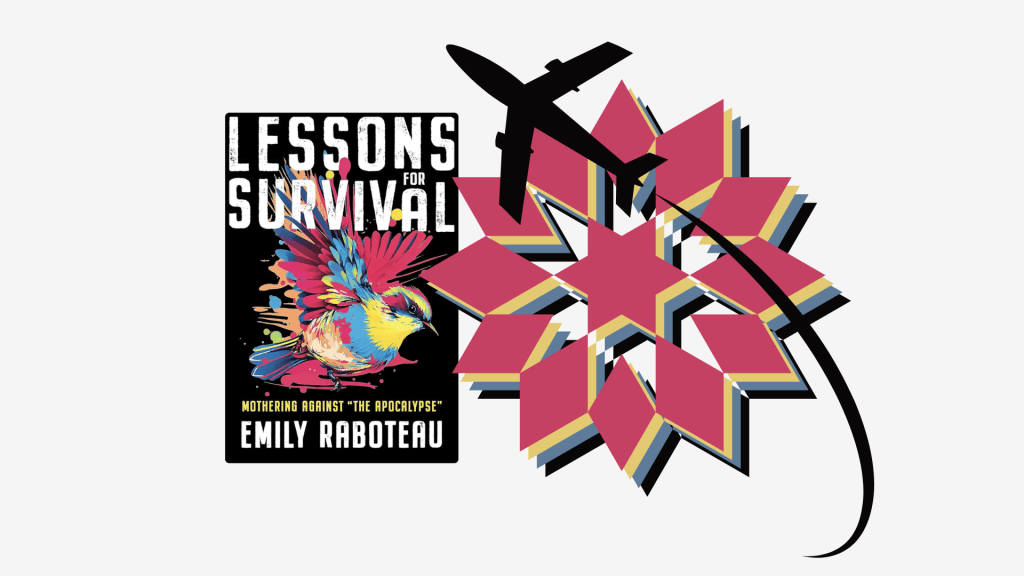
Where to Annotate The Pink Kaffiyeh
A Gift From Salar in 2019
First Annotation
“Nevertheless, he was bringing me back a souvenir—a bright pink kaffiyeh.”
—Emily Raboteau, “It Was Already Tomorrow” p 170
Raboteau’s friend Salar gave her a bright pink Kaffiyeh in June 2019 as a souvenir from Tehran. This detail emerges in one of the collection’s epistolary essays, a diary-like recording of conversations with friends about climate change. Salar told her, from the airport in Tehran (re: ✈️ this detail is important), about land degradation and loss he witnessed firsthand.
A Gift For Edna Three Summers Later
Second Annotation
“We needed a ritual to deliver us. I unwound the bright pink kaffiyeh from my neck and put it around Edna’s shoulders.”
—Emily Raboteau, “Gutbucket” p 256
Mid flight, in the skies over Alaska in 2022 (re: ✈️ why I wanted you to note that Salar was in the airport in 2019), the pink kaffiyeh changes hands again. Raboteau meets Edna, a grieving stranger a seat over. She’s crying. She has lost her mother. So, Raboteau held her. In a moment of strong spiritual clarity, she wrapped Edna’s grief-heavy shoulders with her own kaffiyeh.
When Rabateau notes in this scene that the kaffiyeh “wasn’t a quilt, but it would have to do” (page 256), she’s quilting with words. This is a thread to the previous essay “You Have Been Given,” where, just five pages before this, she told the story of her own grief and parental loss. At her father’s funeral, her family warmed his body in the casket (and spirit in the afterlife) by burying him with a family quilt. She had no quilt on the plane, but she improvised a grief ritual for Edna, warming her instead with the kaffiyeh.
Related Annotation:
“When he died, we dressed him under a quilt. We laid it over his body in the funeral casket. Somehow, we remembered that we should keep him warm.”
—Emily Raboteau, “You Have Been Given” p 251
Quilts for Warmth and Rites of Grief
Reading Lessons for Survival: Mothering in “The Apocalypse,” I felt like Raboteau unfolded her quilt motif at just the right times. Quilts (actual and metaphorical) appeared in the writing when, as a reader, I was longing for something familiar, comforting, and warm. I could count on the comfort and wisdom of this motif because of its origin point in Rabateau’s storytelling. The first quilt appears in the preface. It’s a baby blanket made for Raboteau’s oldest son by her mother.
Tiya Miles, Harvard professor, historian, and 2021 National Book Award winner, explains the quilt motif so beautifully in her New York Times book review of Lessons for Survival. I held onto her words (quoted below) while I read Raboteau’s essay collection. Miles’ insights on the motif influenced how I searched for quilt imagery as I read and annotated the essays.
Excerpt From NTY Book Review: “At her baby shower, she receives a handcrafted quilt as a present from her mother. The quilt, which features an iconic American log cabin design, becomes a recurring motif, as Raboteau dwells on the need for home, the love of home and the impermanence of home, highlighting the plight of climate refugees (and noting that many Americans will one day fall within that category). She also draws on the quilt to shape her book’s artful structure, stitching her essays together according to the log cabin pattern, which joins disparate horizontal and vertical bands of cloth into a harmonious whole.”
“How to Parent in a World Under Siege?” a New York Times Book Review by Tiya Miles from March 12, 2024
Something I Was Specifically Thinking About Early In the Morning
I wondered: Is the pink kaffiyeh still with Edna? Or has it changed hands again? Is it now warming someone else’s grief-heavy shoulders?
 Annotate With Sara