
BOOK REVIEW
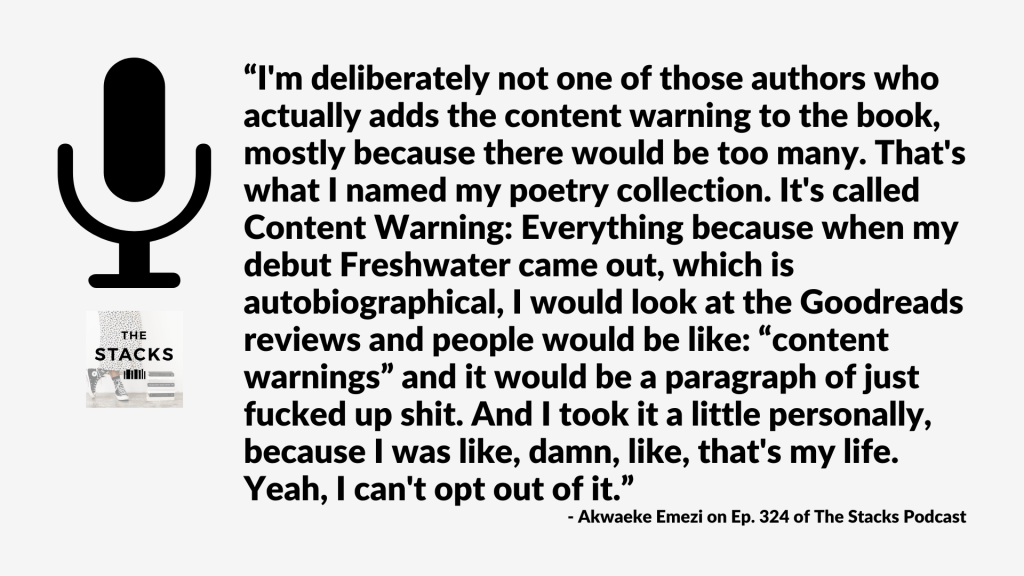
Content Warning: Everything is an evocative, slim poetry collection by Akwaeke Emezi published in 2022. The collection comprises 39 short poems and is less than 50 pages long, but it packs so much within. Emezi’s poems are microscopically personal, but they are also hugely mythical. In fact, this collection is a modern work of Christian mythology that belongs in the hallowed halls of this canon, no question.
Fun Fact: Content Warning: Everything was released one month before You Made A Fool of Death With Your Beauty in 2022.
Content Warning: Everything retells two stories of resurrection and transfiguration1 after violence. The first story is the poet’s (these poems are highly autobiographical ). The second story is Jesus Christ’s.
In this book of poetry, Jesus is an imaginary big brother figure in the speaker’s life. The speaker reimagines what happens before and after his crucifixion from the perspectives of Jesus, Mary, and Magdalene. This reimagining is part of their own journey of resurrection.
This Biblical retelling is a major subplot that I thought was not only daring to include, but also so intriguingly well done! It takes shape inside the collection as a series of eight what-if poems (with a few references to Jesus in other poems too).
I loved how Emezi infused their retelling of a Biblical storyline with the feel of the found family trope, while using the worldbuilding rules for parallel universes. Here’s what I mean by that: Everything that happens to Jesus, Mary, and Magdalene in the Bible has already happened in the poetry collection. Any character or speaker in the collection can reference events in the Bible or has personal memories to draw from. Mary, for example, in the first poem and others, gives Emezi’s mother parenting advice about raising their “little gods.” But, since we are in a parallel universe situation and time has collapsed (hinted at in “parallel” p 32 and “what if my family came to the hospitals” on p 45), Jesus, Mary, and Magdalene are also actively living out the full Biblical plot of their lives in the present day—with Emezi and their mother at their sides. Together, in this alternate reality, they are all everyday people, the closest of family friends. They call on birthdays and visit each other in the hospital during tragedies. Emezi and Jesus are both “little gods2” who grow up together, experiencing the same stuff, both big (like death and transfiguration) and small (ignoring their moms’ calls). This subplot has lots of whimsical elements, but it gets dark, too. It’s incredible to read and was one of my favorite things about this collection.
ANNOTATING TIPS
I Annotated Food Writing in This Collection
Just like in You Made A Fool of Death With Your Beauty, Emezi explores physical, spiritual, and sexual appetites via food writing in Content Warning: Everything. The writing is especially focused on sweetness in both books, but there’s also a huge contrast in the depictions of sweetness between them:
- YMAFODWYB depicts a sensual and fantastical sweetness (re: that iconic mango foam scene!).
- In Content Warning: Everything, the natural sweetness of fruit is the focus, but that sweetness is often juxtaposed with blood or oily, grisly meat.
At an early juncture, I was wholeheartedly convinced that food would be formative imagery for the entire collection. By the time I read the third poem “disclosure,” food details stood out so much I started picking out my annotating materials. Here’s what I noticed and exactly what prompted me too start annotating food:
- the figs and mangoes in the first poem
- “honey and waterwine” in the second
- “a pulped satsuma bleeds dark juice” in the third
Now, A List of the Food Mentioned in Content Warning: Everything
Finishing the book, I realized my instincts were right. Which is the best literary feeling! Thirty out of the collection’s thirty-nine poems have food imagery, and it’s super interesting to look at the mentions of food together.
Good news, dear reader! I typed out all my annotations for you in the list below. Take a look.
- WHAT IF MY MOTHER MET MARY
- a fig
- a mango sticky
- ais kacang
- CHRISTENING
- honey and thick waterwine
- DISCLOSURE
- my food
- i feast on torn herbs and fat gold the wet smear of a perfect yolk seeds burst purple beneath my hands a pulped satsuma bleeds dark juice into my mouth
- PLEASE DON’T REMIND ME WE’RE GHOSTS
- toffee melted into its wrapper, sweet orange powder cupped in your palms, bruising dark with water
- old beer
- WHAT IF JESUS WAS MY BIG BROTHER
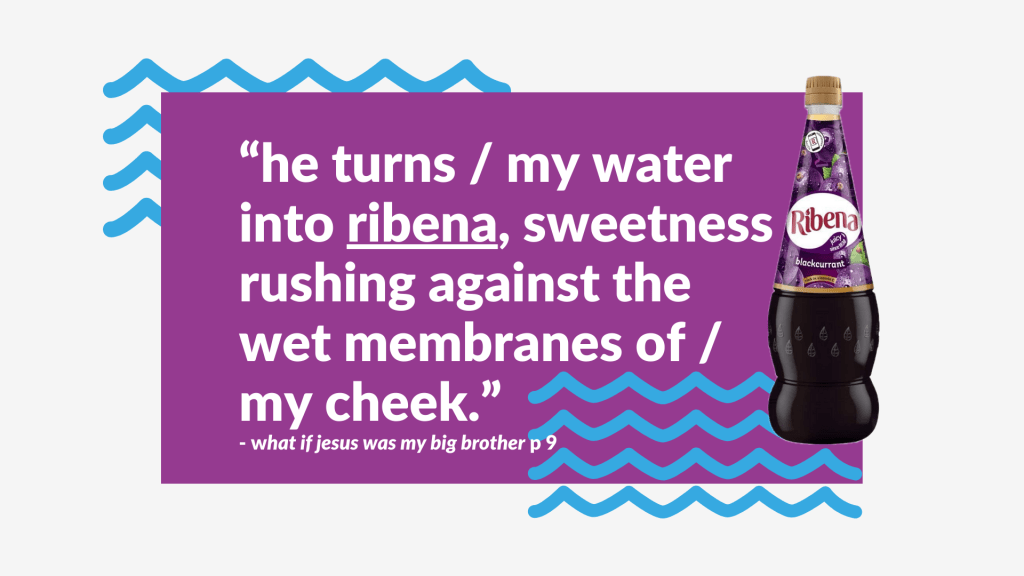
- he turns / my water into ribena, sweetness
- membranes
- agege bread and a tin of sardines, we eat it for a week, soft and / oily like our hearts.
- I THINK MY FATHER IS DYING
- palm oil
- palm fruit
- palm wine
- JULY 28
- the smell of a roti shop
- guavas and parathas
- THIEF
- oiled men
- salt and sweet
- FOLDING FOR A CRUEL LMAN
- your mouth
- your tongue
- your teeth
- wild hunger, the freshness of future
- lost gristle
- oiled whip
- EXCOMMUNICATION
- fresh gethsemane
- eyeteeth
- WHAT IF MARY AUNTIE CALLED ME ON MY BIRTHDAY
- a slippery / crush of green olives, a sweet fig
- wine
- bread
- rotting manna
- FUCK ME IN A FRESH GRAVE
- aubergine velvet
- rum-soaked habanero
- coffee-black
- SELF PORTRAIT AS A CANNIBAL
- The whole poem is about forbidden appetites, but it’s very interesting to me that sweetness comes up at the very end.
- SANCTUARY
- a menu of worlds
- WHAT IF MAGDALENE SEDUCED ME
- hunts me
- chestnut eyes
- HEALING
- he burns cotton and it smells like sugar on fire
- mullein
- usnea
- licorice
- arnica
- I THOUGHT I COULD BE WELL
- still, how I hunger for hunger
- hunt you
- ghost’s tongue
- butchered my ground
- THOUSANDS
- the taste of thousands in my mouth
- grease slicked on my chin
- shiny fat sliding down
- my thousand throats
- ASHAWO
- bruising wine
- WHEN THE HURRICANE COMES THE MEN PROTECT THEIR BROTHERS
- plant his hand in fields
- WHAT IF JESUS SOUGHT VENGEANCE
- halfmeal memories
- an orchard of figs
- fears tastes like a child’s forgiveness in my mouth
- licks the air
- windedark swell
- PARALLEL
- remember the diner after we watched mcqueen
- I WAS BORN IN A GREAT LENGTH OF RIVER
- the air deep / in my stomach
- i rationed it
- WHAT IF MARY AUNTIE EXPLAINED MORTALITY
- the wine-dried mouth
- nostrils / flaring at a dead smell
- OH DELILAH
- gallons of salt pickling your scalp
- I WAS ALONE BEYOND MEASURE
- pockets full of seeds a mouth full of want
- WHAT IF MY FATHER CALLED JESUS A BASTARD
- ox bones
- SELF-PORTRAIT AS AN ABUSER
- in a splash of tangerine
- SALVATION
- new skins
- the sweet pulping
- the roaring field of fresh life
- WHAT IF MY FAMILY CAME TO THE HOSPITALS
- they both smell like vinegar
Three Major Things I Noticed Making This List
- Emezi focuses on two food groups: fruit and meat.
- The poem “self-portrait as a cannibal” feels like a turning point in the food imagery. Food is mostly edible before this poem. After it, food is pretty grotesque.
- Fermentation is a sub-theme: wine, vinegar, pickling, and rot all appear.
Analysis: Is Fruit & Fermentation a Metaphor for Transfiguration?
I think the food fermentation I noticed fits right in with the book’s human transformation themes. After thinking about this for a while, I became so tempted to describe Emezi’s and Jesus’s transfigurations in the poems as spiritual fermentation— as miracles of self-preservation. Here’s how I got there: Fermentation is, after all, a miraculous transformation of food from something dead and perishable to something beautiful that is alive again (with microbes) and long lasting. Picture these: cabbage to kimchi, grain to beer, grapes to wine, honey to mead, soybeans to miso, etc.
Notably, there’s a distinction in the poetry collection between edible fermentation and rot. There’s wine, but there’s also things like dead smells and rotting manna. Food things get pretty grotesque, especially in that latter half of the collection. You’ll read about stomach turning images of pickling scalps and people smelling like vinegar.
Something else I annotated is the collection-wide use of the word spit. Spit obviously is adjacent to appetite and food imagery, but has its own layers of meaning. Honestly, the way Emezi worked spit into this collection deserves its own post and deep dive. But, here’s an overview:
- Humans spit out fruit seeds and pits.
- Humans spit out food that tastes bad.
- Humans spit out words.
- Humans spit out ejaculate after oral sex, which I bring up here because (a) we know it synonymously as seed so it’s fruit/food related and (2) it comes up in the poems.
- All these poems mention transfiguration and resurrection directly or through imagery:
(1) “excommunication” p 18
– I think the transfiguration imagery is how they’re gleaming gold at the end of the poem.
(2) “sanctuary” p 24
(3) “healing” p 26 (Jesus helps them transform)
(4) “what if Mary auntie explained mortality” p 34 (this poem mentions the third day)
(4) “salvation” p 42 (the phrases “new skins,” “fresh life” have the feel of redemption and resurrection imagery”
(5) “content warning: everything” the title poem on page 43 says “i rose from my death” and “i am the fucking miracle” ↩︎ - All these poems mention “little gods:”
“what if mary auntie called me on my birthday” p 19
“what if mary auntie explained mortality” p 34
“i was alone beyond measure” p 37
“what if my family came to the hospitals” p 45. ↩︎
 Annotate With Sara
Response to “Annotating Poetry: Sweetness and Rot in Content Warning: Everything by Akwaeke Emezi”
[…] This posts focuses on an annotation idea for Content Warning: Everything by Akwaeke Emezi. You can read more about this collection, including a review and more light analysis, on yesterday’s post. […]
LikeLike