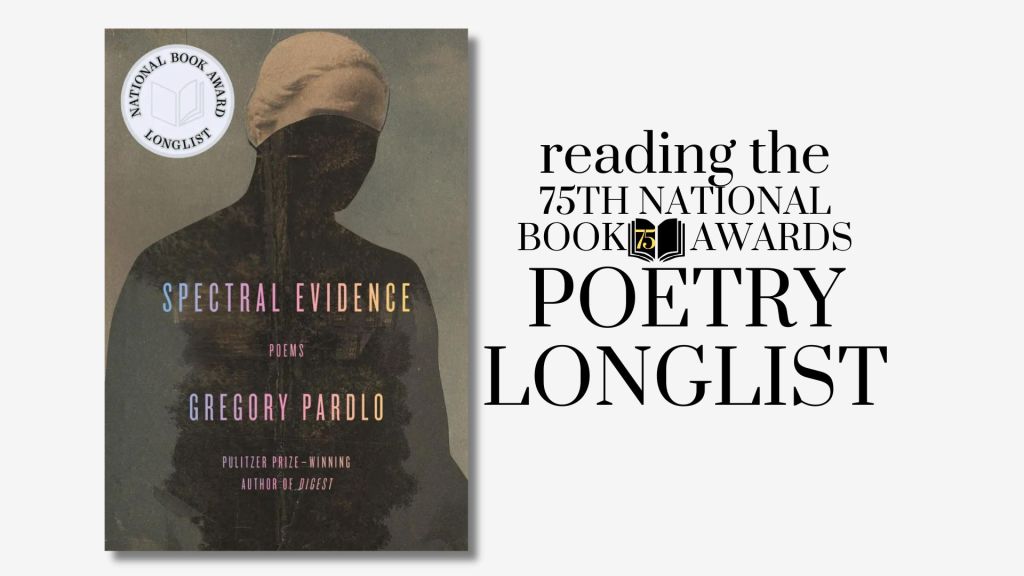
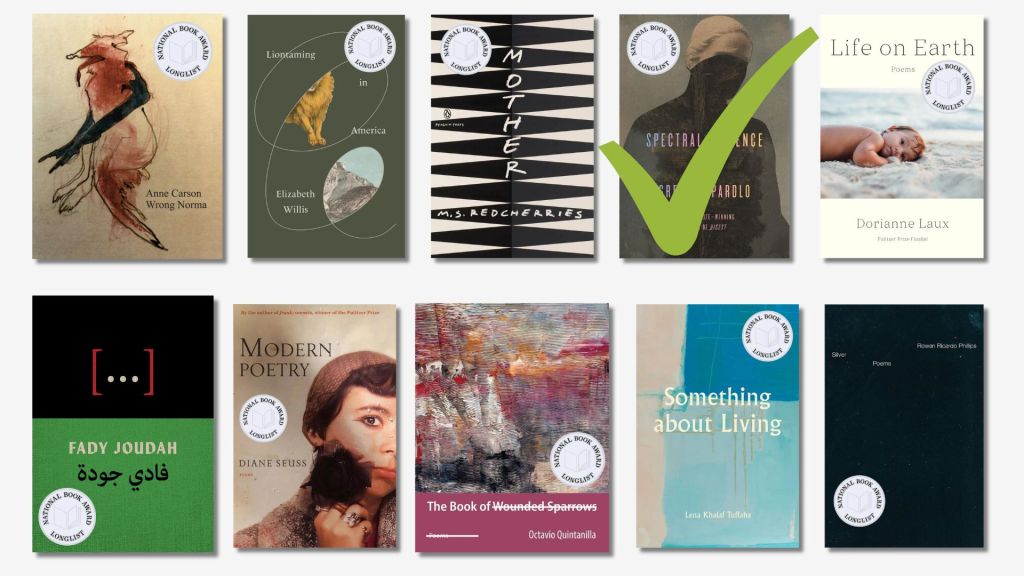
I kicked off my readathon of the entire poetry longlist for the National Book Awards with Gregory Pardlo’s Spectral Evidence. This collection consists of one essay and 45 poems over the course of about 100 pages.
In a nutshell, the poetry is about eyewitness testimonies and the performance of them in American courtrooms and American life. The collection covers both the historical and the personal.
Gregory Pardlo plays with form throughout the collection, going far beyond poetry. In addition to the introductory essay, there is a play, illustrations, ekphrastic poetry, a multiple choice test, and excerpts from primary source documents. Several poems made me think of 1919 by Eve L. Ewing, Build Yourself a Boat by Carmonghne Felix, and Room Swept Home by Remica Bingham-Risher.
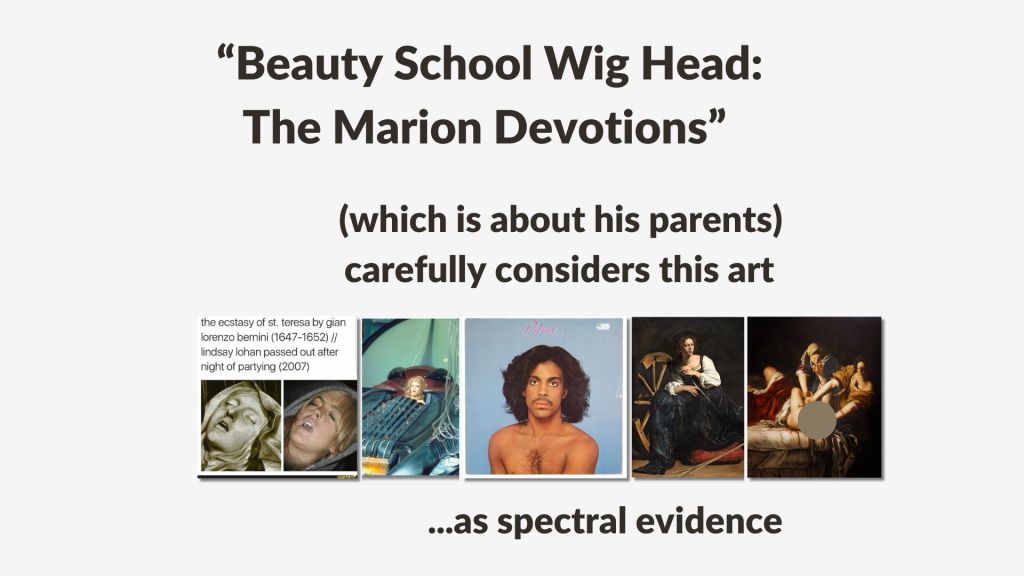
This collection indulged in my favorite type of poetry: ekphrastic poetry. My favorite ekphrasis came in the poem “Beauty School Wig Head: The Marion Devotions,” one of the longest poems the collection. The poem is, at its core, about his parent’s relationship. As he examines it, he carefully considers several works of art. In the end, I felt like all this art formed a body of spectral evidence that illuminated, proved, and disproved things he witnessed between his parents.
What I Annotated
There are many threads and patterns to annotate. I enjoyed noticing and marking all the through lines Pardlo pointed out between the past and present, some of which were heavy, some of which were much lighterhearted. Here are two examples:
1. Heavy Through Line Example
The opening essay titled “Prologue” establishes a clear, but still mind-bending, connection between the testimony at the Salem Witch Trials and the testimony in Ferguson, Missouri by the officer that murdered Michael Brown. This connection is explored throughout the book with many more historical examples.
2. Lighterhearted Through Line Example
Not long after the introductory essay, some levity appears in “Charm for the Transmigration of the Soul,” a delightfully serious poem that reads like a Grimm’s Fairy Tale. In the poem, Pardlo draws a weird but cool comparitve connection between knowledge gained from 17th century Jesuit toadstones and The Reading Rainbow with LeVar Burton. Just go read the poem, ok? It’s one of the best in the collection!
Other Things I Annotated
- parents/parenting,
- when love and fear mix,
- connections between poem series (like the triptych titled “Theatre Selfie,”
- all the wry, charming, and disarming wordplay Pardlo engages in
Overview of Poem Lengths
Most poems are short. 60% are a page long. 22% are two pages long. There are a couple handfuls of three pagers, 10 total (or 11%). Then there are three long poems that are 5 pages or more. I enjoyed the variety.
A Special Note for Father and Cars
Gregory Pardlo has written extensively about his father, who was one of the striking air traffic controllers fired by Reagan in 1981, in Air Traffic: A Memoir of of Ambition and Manhood in America. In this poetry collection, Pardlo’s father is a specter in many of the poems, and I really liked how almost every poem with his dad had conspicuous car in it. Gregory Pardlo included these cars with so much intention, like a foreshadowing device or a teaser for the poem called “Convertible.” Here are the two father/car poems that lead to the big father/car poem “Convertible.”
- Beauty School Wig Head: The Marion Devotions
- Metaphor
The Poem Pair I Want to Study Closer
“Question and Answer” and “Know Yourselves” go together and are side by side in the collection. I could spend more time with these. I found them to be decisive but tender and the moment they cover (and the aftermath) were really interesting. The first poem in the series “Question and Answer” is Pardlo’s testimony of when a student attempted to put his ideas on trial. The second poem “Know Yourselves” is a reflection.
“Had to be exhausting terrorizing people 24/7. It’s why Americans need guns. We’re terrified of the ghosts we’ve inherited.”
from “Know Yourselves”
 Annotate With Sara