
I made a hasty assumption about Ta-Nehisi Coates’ new book The Message before I even started reading. Based off the title, I assumed the book would offer a singular, clear message. I imagined taking away a heavy, but gorgeous piece of wisdom with relative ease. I thought I would feel a clarion call to action. I was pretty wrong about this.
No easy-to-come-by, solitary, and breathtaking message exists in The Message. Coates is not a fan of teaching things in such a way. I figured this out by page 73 where, for the first time, Coates uses the word message. The title comes up when he points out the subliminal messaging of rote memorization-style learning, which is so common in schools. Introducing a quote by Paulo Freire, he says:
“But the medium is the message: What is being learned by students is not just the facts they memorize but the purpose of this knowledge […].
Freire explains, in the quoted text, how consuming and regurgitating information is passive learning. It requires no significant “critical consciousness” (Freire’s words, p 73) engagement, or questioning. Students succeed by being parrots, not by being critical thinkers.
Omitting Palestine in a Life-Changing Narrative Was a Mistake
Coates reveals how he suppressed an aspect of his own “critical consciousness” in 2014 when he was at The Atlantic writing “The Case for Reparations.” In this famous article, Coates looks at Germany’s own case for reparations after the Holocaust, specifically how the German government paid reparations to the budding state of Israel. This Germany-Israel examination is offered as a sort of blueprint for reparations for slavery in America.
Palestine was on his mind when he wrote about Germany and Israel, but Coates omitted Palestine in his narrative, deferring to The Atlantic’s status quo for reporting on Israel and Palestine. This is something he deeply regrets and wishes to make amends for in this book1.
“I had then a vague notion of Israel as a country that was doing something deeply unfair to the Palestinian people, though I was not clear on exactly what.” – p 132
“Within days of publishing “The Case for Reparations,” I began to feel the mistake. But it took years for the depth of that mistake, and thus my own debt, to compound.” – p 141
One way I choose to read The Message is by viewing it as a long, careful work of redaction, a book that serves to meticulously correct Coates’ own journalistic record. As my friend Melissa of But I Brought Books said when we texted about this book, Coates is “showing his work.” He’s brutally honest and deeply personal about his mistakes, cataloguing both his shame and his lifelong path to enlightenment on Palestine.
Coates’ personal transparency and accountability is the message of The Message for me. He shows his hand in a vulnerable essay collection, which transmits many valuable messages, e.g., it’s human to change, to redact, to grow, and to learn and unlearn. How amazing that I get to have this written record about how to falter and recover with dignity, penned by one of the greatest writers of our time, on my bookshelf.
I recommend readers approach The Message not just as a work of redaction but, more importantly, as a memoir. Despite the bad takes out there, this is not a book about Palestine and Israel. It is a memoir about a man admitting he made a mistake. It is a story about a man confronting the sting of shame and not letting the shame take hold of him. I think that, as a message, is incredible.
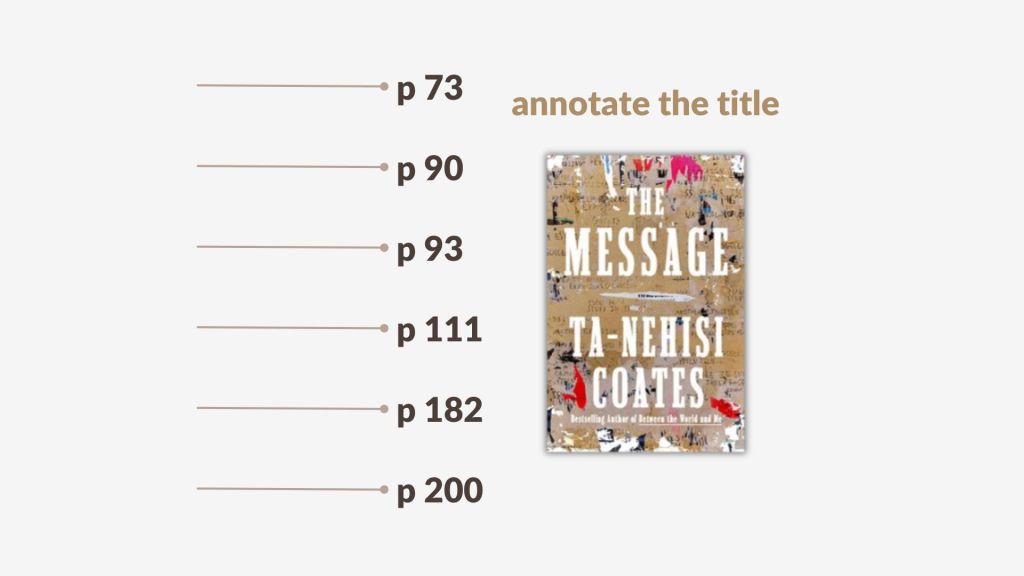
Annotating Guide: How to Annotate the Title
The title is mentioned uniquely 6 times, so you’ll need 7 tabs of the same color to annotate your copy of the book. Remember, one of the tabs should go on your cover page in a tab key. I simply wrote “title” on the tab in my own key.
Need annotating supplies? Please check out my friend Shelbey Monae’s Amazon Storefront!
- page 73 “the medium is the message”
- context: rote memorization learning
- page 90 “he believes in you and your message”
- context: book banning
- page 93: “contrary to the story’s intended message”
- context: The Ant and The Grasshopper (Aesop’s Fables)
- page 111: “the implicit message that learning does not belong exclusively in schools”
- context: independent learning with books
- page 182 : “under Hitler’s boot, the message was not missed”
- context: The Holocaust
- page 200: “the state had one message to the Palestinians…the message was….the message was conveyed brutally”
- context: Israel & Palestine
- On page 222, Coates calls this book an “act of reparation.” ↩︎
 Annotate With Sara