CONTAINS SPOILERS

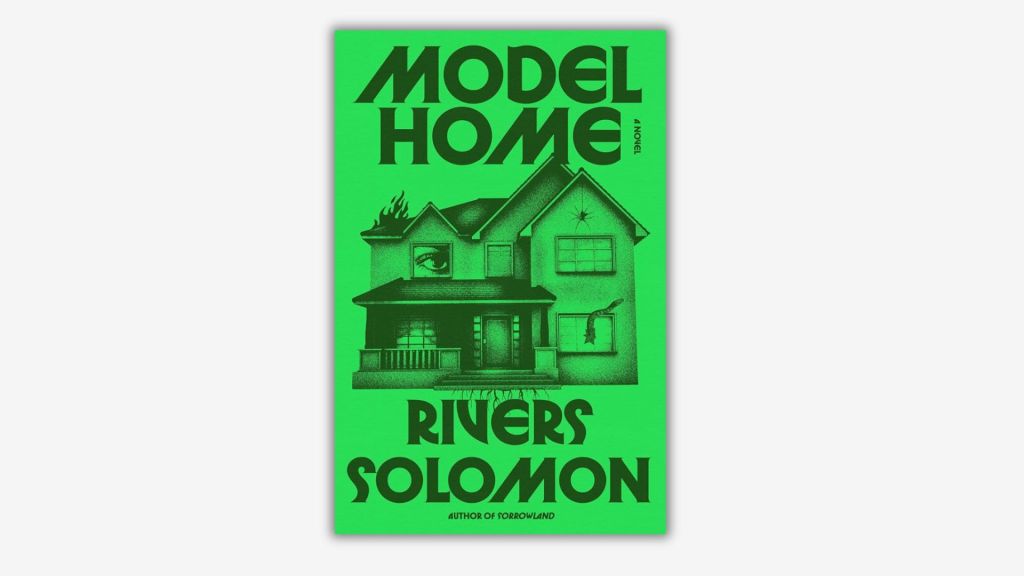
Much to my surprise, The New York Times’ Book Review ran a scathing review of Model Home, the newest novel by Rivers Solomon. I was enthralled by this book, as were a lot of my Bookstagram mutuals1, but the Times was not. Their review dismisses the novel as an “overwrought cautionary parable.” Allow me, in my state of shock, to invoke Newton’s Third Law of Motion because what the reviewer loathed I with equal but opposite force loved.
Predictable and Plodding Plot or….
A Pacing Style That Emphasizes The Slow-Acting Poison of Racism?
“Predictable and plodding” is what the NYT Book Review said of Model Home‘s pacing. Oddly, this description worked for me in a positive way. Their stark diction helped me to see Solomon’s pacing in relationship with bigger themes in the book (like racism and torture).
“Unfortunately, Solomon is too narrowly focused on reiterating the depth and ‘inevitability’ of pain to make good on this propulsive setup, their style too predictable and plodding.“
“In a White Gated Community, the Only Black Couple Wind Up Dead” NYT Book Review, 9-28-2024
Solomon’s choice to slow the pacing down is purposeful. It not only messes with reader expectations for the horror-thriller genre, it also puts readers in main character Ezri’s confused headspace. As readers question the boundaries and expectations of genre, Ezri finds themself off balance and questioning the nature of memory, perception, and reality.
If slow pacing is something you loathe, let me promise you that the propulsive, whiplash-inducing ending is worth the wait.
Solomon’s slow pacing choice also runs parallel with the type of horror at the heart of Model Home‘s plot. Racist humans, not paranormal beings, are the major force of evil in this book. A white-led, racist HOA spearheads a violent, decades-long campaign to drive the Maxwells, a Black family, out of the neighborhood. (The Maxwell’s bought and live in the neighborhood’s stunning model home.) The New York Times Book Review worked this storyline into their title for the review. I (positively) thought their title distilled the book in a unique, gripping way: “In a White Gated Community, the Only Black Couple Wind Up Dead.”
While racism can show up in swift, violent, and shocking attacks or hate crimes, on a daily basis the mechanisms of racism are often small, insidious, and cyclical, e.g., very “predictable and plodding” acts of unfair policy making, discrimination, gaslighting, and micro aggressions. Since white violence and anti-Blackness operate in well known and studied patterns, I found the artistic alignment between Solomon’s slow pacing and chosen subject matter very compelling, creepy AF, and insightful.
Is Model Home An Overwrought Book?
Ultimately, I don’t think so, but this line of criticism in the NYT review gave me pause:
“But the reader can allow only so much ornamentation before the actual suffering loses resonance.”
– “In a White Gated Community, the Only Black Couple Wind Up Dead,” NYT Book Review, 9-28-2024
I wanted to critically think about this point because I tend to gravitate toward heavily ornamented writing and am not typically critical of it. I really like poetic devices, repetition, lyricism, and metaphors (that take a whole book to build). Ultimately, I decided that yes I am biased toward ornamented writing, but also the ornamentation that Solomon does in Model Home is effective, and here’s a few reasons why.
Highly Ornamented Writing Ties In With The Model Home Aesthetic
Model homes are usually the flashiest homes in a new build subdivision. Developers deck out the model home with the most enticing floor plans, top-of-the-line fixtures, fancy finishes, and upgraded appliances. The homes are meant to be flashy.
Like a housing developer, I think Solomon intended to deck out Model Home with bells and whistles. Lyricism, repetition, musicality, and winding metaphors are enticing creature comforts for me as a reader. Honestly, if a horror-thriller has these little glimmers of beauty, I’m sold! I need a little beauty in my literary environment when subject matter gets overwhelming – as it does in this book.
Model Homes‘s literary allusions act like bonus rooms in the book’s floor plan. They’re doors opening up to luxury spaces that other writers and poets have designed. Allusions are a literary trick that makes this book feel so much bigger than it looks. Plus, Solomon makes some great allusions.
To name a few, Solomon alludes to
- Octavia E. Butler’s Lilith’s Brood (Ch 16, p 113)
- Toni Morrison’s The Bluest Eye (Ch 35, p 275)
- Langston Hughes2 poem “Harlem” and Lorraine Hansberry’s “Raisin in the Sun” (Ch 23, p 166)
- Ursula K. Le Guin’s short story “The Ones Who Walk Away from Omelas.” (Check out my annotating guide “The Omelas Child in Model Home by Rivers Solomon” for this one)
I also annotated dozens of moments featuring 90’s pop culture references, music and movies from across decades, and historical events. As an (almost) elder millennial, these references are close to my 90’s kid heart, which makes them fun to see in the book. They have literary merit too though. These references all speak to cultural nostalgia and memory. This book is deeply invested in exploring memory on many levels, and the constant peppering of media references is just another layer Solomon adds to the book’s central question: What shapes our individual (and collective) memories and perceptions?
Last Thing, I Like Melodrama
Briefly, I just want to note my equal and opposite reaction to the idea that a “surfeit of melodrama” is a bad thing in Model Home. What if melodrama is a device that instills more horror in the plot? I get this idea from a piece of film criticism that taught me to think of melodrama as scary. That’s a little too much to get into or simply repeat here, but here’s a link to the piece if you’re interested in exploring the idea. Her synopsis of the melodrama in The Notebook (the movie adaptation) made me gasp.
- “Why Melodramas Are Scarier than Horror Movies” by Payton McCarty-Simas.
The Novel’s Bigger Picture of Global Suffering
Solomon’s vision for Model Home is far reaching. They are not just writing about the suffering of a Black family in a white neighborhood at one point in time. They don’t even confine their allegory to the wider history of Black suffering in America. This novel is allegory for land strife, racial suffering, and racial scapegoating happening globally.
Like The Message by Ta-Nehisi Coates (which published on the same day as Model Home!) Rivers Solomon’s uses their book to make a direct connection between state violence that Black American, Jewish, and Palestinian people have faced.
Solomon, who is Black, queer, and Jewish, examines these connections a few times. In one of the last references to Le Guin’s short story “The Ones Who Walk Away from Omelas,” Ezri’s thoughts spiral out to nationalism and military force (see Chapter 25, p 176). For the most direct tie in between Black, Jewish, and Palestinian experiences of oppression, see Chapter 30 page 211. Solomon also mentions Palestine in their Acknowledgments section for the book.
In closing, I want to offer an annotating guide for the motif of circles. This motif is one of the subtler ones in the book, but it’s powerful. The circle imagery ties in with the book’s exploration of lineage, unending suffering, and cycle breaking. You will need 8 tabs of the same color to annotate this motif. One tab will be for your tab key.
Annotating Guide for Circle / Cycle Imagery
Ezri gets pulled into 677 Acacia Drive’s orbit.
- Chapter 16, p 113
“the rope of pain we are all encircled in”
- Chapter 20 page 137
Ezri and their co-parent Caroline decide to take Elijah out of a Steiner (also known as Waldorf) school because of Rudolf Steiner’s Nazi-ties and because “his educational philosophy revolves around the idea of a perfect, Aryan childhood that mythologizes European histories, cultures, and lifestyles…”
- Chapter 26, p 184
Emmanuelle asks Elijah to play piano and sing at her grandmother’s service. Elijah chooses “Will the Circle Be Unbroken?”
- Chapter 28, p 194
- Chapter 29, p 210
Elijah thinks of the mathematical constant pi when she’s feeling endangered.
- Chapter 32, p 232
Emmanuelle tries to break the cycle of haunting in the house with a ritual, enclosing herself in a circle of salt.
- Chapter 33, p 244
Footnotes:
- Check Out @dejandherbook’s review, @shelbeymonae’s review, @readwithneleh’s review, and @margauxreadit’s review and follow all four of these readers on Instagram if you don’t already! ↩︎
- Another Langston Hughes poem “Tired” is mentioned in the book too in Ch 31, p 230. ↩︎
Need the book? If you plan to purchase from Amazon, please use this affiliate link that supports a fellow book lover and content creator!
 Annotate With Sara