
As a nosy person and an eavesdropper, epistolary writing is one of my favorite modes of literature. I will jump at the chance to read someone else’s public private letter! From its first page, The Message by Ta-Nehisi Coates is clearly an epistolary work, so I was eager to dive in.
On a first read, I thought The Message by Ta-Nehisi Coates was a long, four-part letter. Pure and simple. Coates opens the book declaratively in the epistolary form with a greeting. “Comrades,” he writes, and the salutation is set off with the typical letter formatting, a comma and then a line break.
We are so clearly in letter territory after the first word that I didn’t bat an eye at this epistolary setup during my first read. It felt like a nice extension of Between the World and Me (BTWAM), which is also epistolary. (Coates writes the whole book to his sons.) Coates was also pointedly clear about who he was writing to in The Message (a group of former students at Howard University) and why:
“I’ve addressed these notes directly to you, though I confess that I am thinking of young writers everywhere whose task is nothing less than doing their part to save the world.”
– Ta-Nehisi Coates, The Message, “I: Journalism is Not a Luxury” p 20
On my first read, I didn’t think the form went deeper than what I’ve shared above, and that was my mistake. In my lack of curiosity, I missed the twist!
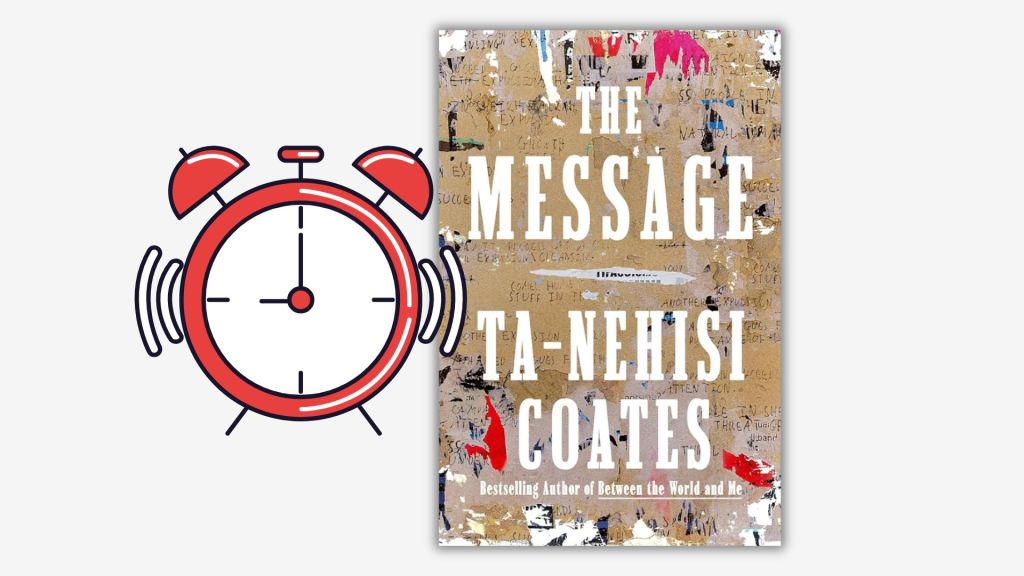
Missing This Twist: Coates is Turning in a Late Assignment
The Message is the completion of an assignment, the fulfillment of a promise Coates made to his students:
“I promised I would submit my own essay for the next workshop…But when the semester ended, I had produced no essay.”1
Years later, he did not stop thinking about the promise. Ostensibly, that very promise spurred the existence of this book. The Message is his “belated assignment,” which interestingly, he characterizes as “notes” on various topics — not as finished essays.
Seeing the words “belated assignment” and “notes” again on my reread changed how I saw the whole conceit of this book. It did not hit the first time around that Coates wrote The Message, in part, to tie up this important loose end with his students.2 Finally turning in his assignment must have felt so good, and my goodness, how cool must it be to be one of those former students now reading this book?! I would love to talk to one of them about their reading experience.
My reread forced me to shift how I see the structure of the book precisely because of the words “assignment” and “notes.” Part I is indeed a letter, but I see it now more like a formal academic cover letter with three attachments, something a student might turn in to a professor. In turn, I see Parts II, III, and IV as the actual late assignments. Part I is a courtesy: the introduction of the assignment to his students, the explanation of tardiness, and the formal hand over of his work for critique and workshopping.
My Reread Left Me With So Many Questions
Is The Message a finished work?
For me, recasting the four components of this book as cover letter plus three long overdue essays complicates my understanding of this book.
Since Coates calls this book a “belated assignment” and characterizes his words as “notes,” are the essays unfinished works? Is The Message an active work-in-progress? What about timing? Why turn it in now at this point in the process? What does he plan to do with the public feedback or the student feedback he receives? Does he plan to rework anything?
Who Is The Intended Audience?
Because I’m reading the book, do I get to be an honorary student of Coates’? (a dream!) In what ways (if any or none at all) is Coates encouraging me, the average reader and a white reader, to workshop his essays alongside his actual former students?
Am I part of the group of young writers he addresses? Technically, my Bookstagram mutuals and I are writing a lot of posts about this book, and a lot of us happen to be younger than Coates. Just a fun thing to ponder…
Why was it important for Coates to sustain the epistolary form after the opening letter?
All three essays feature the word “you.” Coates so consistently readdresses the comrades from the opening letter that he ends up repeating “you” over 200 times in the book.3
Why frame this book as a long open letter and assignment that gets turned into a specific group?
How did he see this affecting reader engagement? Was this something he always planned on doing? Did any of his students ask him to do this?
Was this book always written with his students in mind or did this conceit emerge somewhere else in the writing process?
Was “comrades” always the opening line, or did he experiment with other salutations?
What is this book’s relationship to Between The World and Me, which is also epistolary?
How did picturing a specific cohort of students, instead of his sons (like he did in Between The World and Me), affect his writing process this time around?
Citing the Spark4: I’m Pondering Audience Today, Thanks to The Stacks Podcast
The reason I’ve been considering questions about audience (and my role within it) to begin with is because Traci Thomas, host of The Stacks Podcast, has trained me to think of audience all year. Audience is a poignant topic she often brings up with authors on her show, which airs every Wednesday.
Due to Traci’s influence, I came up with this blog post in the first place and wrote out questions about audience as I read The Message. My bookish wish at the moment is for Coates to go on Traci Thomas’s show. I bet they would dive into the topic of audience and maybe hit on some of these questions haunting my mind.
In case you missed it, I’m talking about annotating The Message with my friends Shelbey and Jess twice on their podcast this month. Be sure to check out The League of Extraordinary Readers!
Footnotes
- Page 20. ↩︎
- I was too focused on this book as an act of journalistic correction with Coates aiming to correct the record on his views on Israel and reparations, which differ from what he wrote in 2014 in The Case for Reparations for The Atlantic. ↩︎
- Some “you” and “yours” belong to quotations by other writers, but most of the “you”s refer back to “comrades.” ↩︎
- This term and concept comes from All The Black Girls Are Activists by ebony janice. ↩︎

