Exploring The Adaptation’s Accuracy & Nitty Gritty Details
EP 3: A Daguerreotype of God seems to be taking the most liberties with the original material so far. There are two moments of dialogue in this episode hat I could absolutely pass on. To me, they are extraneous and add a fumblingness to Úrsula’s formidable character that isn’t from the text.
After you read, please tell me: What do you think? Am I wrong, too harsh? Did you find textual evidence that supports these moments?
1. Úrsula’s (Made Up) Line About Sisterly Love.

When Rebeca arrives, Amaranta is understandably apprehensive about a new adopted sister. Úrsula placates her with “You can trust a sister with anything.”
Excuse me, what?!
This line doesn’t hit the right spot for me, and I think it’s made up1.
These sisters are about to have one of the most epic lifelong feuds ever in literature.
So, was this line meant to be wry or funny? Is it a cutesy setup for the viewing audience who hasn’t read the book and does not know Rebeca’s and Amaranta’s story?
I have LOVED how truthful this show has been to the book so far. So, without a textual anchor, this line feels like campy dramatic irony, and I wish they would have left it out.
2. Shoehorned Line? Arcadio Didn’t Deserve To Overhear That!
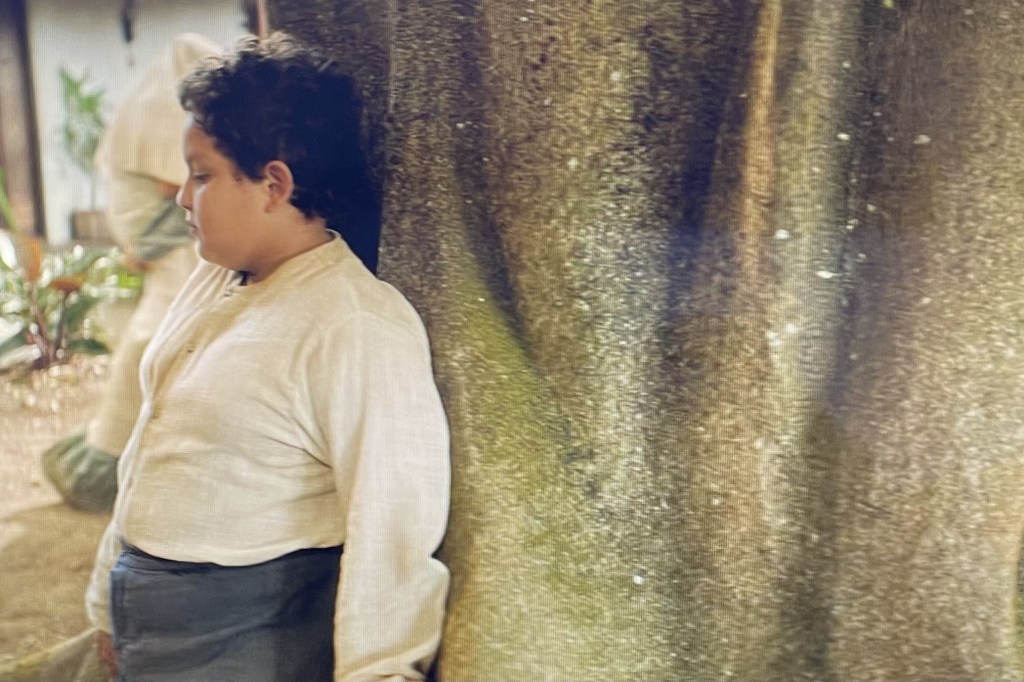
In the beginning of Episode 3, young Arcadio overhears Úrsula say something no kid should hear:
“I don’t know when this house became some kind of orphanage. As if Arcadio wasn’t enough already.”
– from EP3: A Daguerrotype of God of Netflix’s Adaptation of One Hundred Years of Solitude
For two reasons, I felt miffed by these lines.
(1) This line indicates that Arcadio might be encouraged to find out who his true parents are one day. Such a search and revelation NEVER happen in the book.2 In fact, Arcadio has a very Oedipal misunderstanding with Pilar as an adult because he doesn’t know who she really is! (He tries to sleep with her in chapter 6).
So what is this line doing here?
Is the show going to depart from the book? Will it let Arcadio’s character find out about his true parents? What kid would overhear this and not try discovering what was meant by it?
(2) The other reason I wish there was more textual basis for this exact line and heartbreaking moment is because, ultimately, I don’t want to see Arcadio’s villain origin story pinned down to a simple faux pas like this. So far, the show has been doing a good job quietly showing Arcadio’s neglect and precarious sense of belonging in the family.
This line just felt out of pocket and inserted into the show to provide some easy context for Arcadio’s villain origin story as the future tyrant ruler of Macondo. Or to explain his adult relationship with Úrsula, which will end up being really caustic.
I Know You Want To Get Into The Original Text!
Read About Arcadio’s Childhood From The Book
“Úrsula interpreted it as the return of the strayed lamb. But she was mistaken. She had lost Arcadio, not when he had put on his military uniform, but from the beginning. She thought she had raised him as a son, as she had raised Rebeca, with no privileges or discrimination. Nevertheless, Arcadio was a solitary and frightened child during the insomnia plague, in the midst of Úrsula’s utilitarian fervor, during the delirium of José Arcadio Buendía, the hermetism of Aureliano, and the mortal rivalry between Amaranta and Rebeca. Aureliano had taught him to read and write, thinking about other things, as he would have done with a stranger. He gave him his clothing so that Visitación could take it in when it was ready to be thrown away. Arcadio suffered from shoes that were too large, from his patched pants, from his female buttocks. He never succeeded in communicating with anyone better than he did with Visitación and Cataure in their language. Melquíades was the only one who really was concerned with him as he made him listen to his incomprehensible texts and gave him lessons in the art of daguerreotype. No one imagined how much he wept in secret and the desperation with which he tried to revive Melquíades with the useless study of his papers. The school, where they paid attention to him and respected him, and then power, with his endless decrees and his glorious uniform, freed him from the weight of an old bitterness. One night in Catarino’s store someone dared tell him, ‘You don’t deserve the last name you carry.’ Contrary to what everyone expected, Arcadio did not have him shot.” (page 114)

One Thing I Like About This Arcadio Moment
The Chestnut Tree in the Shot
The symbolism of the tree in the shot is great. Because this is the chestnut tree that Arcadio’s grandfather, José Arcadio Buendía, will live out his old age tied to. It is the tree in the marketing materials. It is the tree that becomes an overt symbol for the fate that’s tied to every branch of the Buendía family line.
So, Arcadio leaning against it in secret in this scene and eavesdropping is special. It speaks to how his character, in the book, never learns the secret of his parentage. His whole life, he ironically never overhears the truth about what branch he belongs to on the Buendía family tree, when pretty much everyone around him knows1.
- He’s Pilar Ternera and José Arcadio Jr.’s son. ↩︎
 Annotate With Sara