LOW SPOILER (WORLDBUILDING DISCUSSED)
Let’s Begin
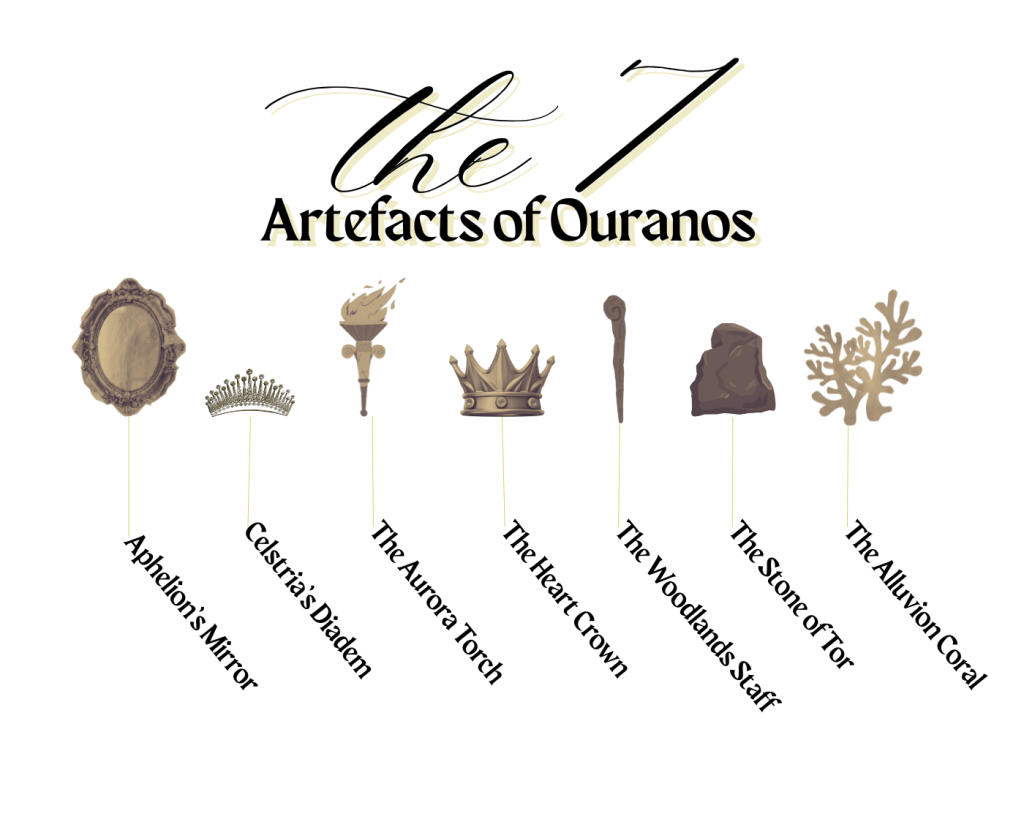
The sentient magical object trope is an oldie but a goody, and the Artefacts of Ouranos series by Nisha J. Tuli lovingly celebrates it. Tuli’s worldbuilding centers on seven different magical and sentient artifacts known as the Artefacts of Ouranos. Each one, being just an ordinary-looking object, hides in plain sight usually in the throne room of each kingdom. Their everydayness decidedly belies their import to all of Ouranos.1.

Magical Objects With Purpose: Political & Environmental Stability
Ouranos’ god, known as the Empyrean, created the seven Artefacts of Ouranos in response to a period of political and environmental upheaval. The Artefacts are essentially safety nets. Each kingdom has one, and they not only ensure certain fair political processes, they also provide a measure of environmental protection.
Favorite Thing About This Trope In This Series: It’s All So Straightforward!
How these objects impact governance is simple to understand and rolled out in a smooth (not info-dumpy) way. The clarity provided about the Artefacts’ provenance, why they have magic, and why they have sentience is such a relief. There’s no guessing.
A Quick Artefacts Overview:
The Artefacts are conduits of Ouranos’ naturally occurring magic, which is a fairly volatile resource when unmanaged. The Artefacts encapsulate their specific kingdom’s excess magic and channel it safely into the crowned ruler. The ruler therein becomes a caretaker, not only of the Artefacts but of the land’s magical resources too. The Artefacts choose the rulers themselves and strive to identify a fae who will use magic to rule justly. They’re not perfect at picking though!
Their checks-and-balances design is A+:
The Empyrean had the power-hungry nature of human beings in mind when they crafted the Artefacts. Each object is infused with checks-and-balances:
- The Artefacts are loyal to Ouranos first and foremost. The well-being of their assigned kingdom comes second.
- The Artefacts ensure peaceful transfers of power between monarchs. In the first age of Ouranos, the Artefacts were bestowed to the very first kings and queens. But since then, the Artefacts have chosen the best successor themselves. The chosen one is known as the kingdom’s Primary.
- The Primary loses their status if they attempt a coup. If the Primary proves unworthy, their power goes to another Artefact-chosen fae.2
- The Artefacts bestow Imperial Powers (special magic for rulers only) on the rightful King or Queen, once they take the throne. This is known as an Ascension.
- The Artefacts also shepherd rulers through Descending, which is a type of assisted death, something a monarch can choose when they are ready for the next life. The Artefact sends the outgoing ruler to the Evanescence, a heaven-like realm that’s solely for past rulers and their spouses.
Like all systems of checks and balances, the Artefacts are not perfect. Throughout the ages of Ouranos, some unscrupulous rulers find loopholes in the magic of the Artefacts. That’s where the story’s high-stakes political intrigue stem from. Ouranos’ story, in a nutshell, is a story about rulers who find the loopholes and abuse power.
Ouranos’ Artefacts Made Me Nostalgic For These Specific 90’s / Early Aughts Fantasies
Tuli’s take on the sentient magical object trope brought up lots of nostalgia. Her Artefacts fit right into fantasy’s long, rich tradition with this trope. Here’s some of the best-known magical-object lore that I reminisced about as I read this series:
- LOTR’s rings of power
- Ghostwriter (on PBS)
- The Brave Little Toaster
- Clippy
- The Wardrobe from Narnia
Are the Artefacts Lord of the Rings Coded?
A nefarious sentient magical object creeps me the fuck out. Thankfully, Ouranos’ Artefacts are the benevolent kind of sentient magical objects. In fact, I don’t think there’s a mean or tricky bone in the Artefacts’ bodies, and I really needed that crutch.
These books deal with heavy content, and it was a relief, in this once instance, not to have to worry about Lor’s safety whenever she interacted with the Artefacts. They’re not perfect guides for Lor, but they’re inherently good.
Even though personality wise, the Artefacts have nothing like the corrupted power of the rings from the Lord of the Rings, the Artefacts still felt very lovingly LOTR coded (minus the evil parts). I’d even go as far as to say that the Heart Kingdom’s all-powerful magic feels like a distant but kind cousin of Isuldur’s Bane. A one crown to rule them all sort of situation!
I really loved the helpful nature of the Artefacts in this series.
Tuli’s Artefacts could totally be friends with my favorite magical objects from childhood. Would they get along with Clippy, Microsoft Word’s (’97) helpful, earnestly annoying Office Assistant? Why yes! Would they be buddies with Ghost Writer (from the 1992-1995 PBS show)? Of course! They have so much in common. Like Ghost Writer, the Artefacts are spirit-imbued, unpredictably communicative, amazing, and knowledgeable. Plus, they’re always ready to help Lor answer a question!
The Portal Magic of The Artefacts
The Artefacts act as portals in way that was very reminiscent of the Wardrobe leading to Narnia. The Artefacts are very normal looking household things (mirrors, torches, staffs, rocks, etc…). They’re even hung like regular old decor in the throne rooms of various kingdoms. But, when Lor can make contact with an Artefact, it has the ability to transport her into their cozy little alternative-dimensions for a chat. I loved that power and those moments!
BIGGER PICTURE: Anthropomorphism In Books Is Comforting?
When an author of any genre can successfully confer humanness onto an object, I’m a happy reader. I love this practice in writing, whether it happens in fantasy, poetry, or litfic.
If it’s good, it’s good!
Of course, we have different names for this literary device across genres. We might call it a magical object trope in fantasy, anthropomorphism in poetry, or personification in literary fiction. But, no matter the genre, I am drawn to writing that engages with animism. I like literature that gets me feeling sentimental for objects.
I recently looked up why this is a thing for me on Google. Turns out anthropomorphizing is something we humans do for “comfort,” “pleasure,” and a sense of belonging.3 I can see that.
Also, how cool, right? Because…..those feelings are the very same feelings I try feel when I lose myself in books.
Annotation Suggestions for The Artefacts
If you’re interested in annotating key wordlbuilding facts about the Artefacts in the series, I’ve got five quotes you. See below.
Annotation 1: The Fate of The Sun King by Nisha J. Tuli, Ch 33 p 341
They waved their hand, and seven objects appeared, hovering around them in a circle. A golden mirror. A silver crown with a red stone. A black torch. A wooden staff. A shimmering rock. A pearlescent coral. And a white diadem inset with moonstones.
Annotation 2: Fate of the Sun King by Nisha J. Tuli, Ch 52, p 524
“When we gathered the kings and queens here, we gave each of them a gift. Of course, you are familiar with them. Seven Artefacts used to tether Ouranos to the magic so it could come under their control and would no longer consume them….their main function was to bind the humans to the magic and ascend them to High Fae, and that has been their main role for generations.”
Annotation 3: The Fate of The Sun King by Nisha J. Tuli, Ch 33 p 341
“These seven Artefacts are tied to the magic of your homelands. From this day on, each of you will be bound to them and, in turn, to the magic itself.”
Annotation 4: Fate of the Sun King by Nisha J. Tuli, Ch 52, p 524
“For the magic to transfer, each ruler was asked to bind themselves to their Artefact. Their life would become one with it, and when they passed on, they would remain with it forever.” I allow that thought to settle. “That’s why they talk to me. They’re alive.”
Annotation 5: The Tale of The Heart Queen by Nisha J. Tuli, Ch 12, p 98
I guess most people don’t know the spirits of the former kings and queens of Ouranos inhabit them.
- The ‘e’ in Artefacts is purposeful. That’s how it’s spelled in the books. ↩︎
- “There is a condition of the Artefact’s magic that if the Primary heir kills the king or queen in power, then they’ll lose their magic and a new Primary will be named. But not just a new Primary. The power of the royal family would transfer elsewhere.” Rule of the Aurora King, Ch 14, p 137 ↩︎
- (1) “The emotional responses experienced in object anthropomorphism often involve a sense of comfort and pleasure.”
(2) “Interaction and imagined interaction with anthropomorphized objects offers the opportunity to shape self-efficacy.”
– both quotes are from Anthropomorphism and object attachment by Echo Wen Wan and Rocky Peng Chen ↩︎
 Annotate With Sara