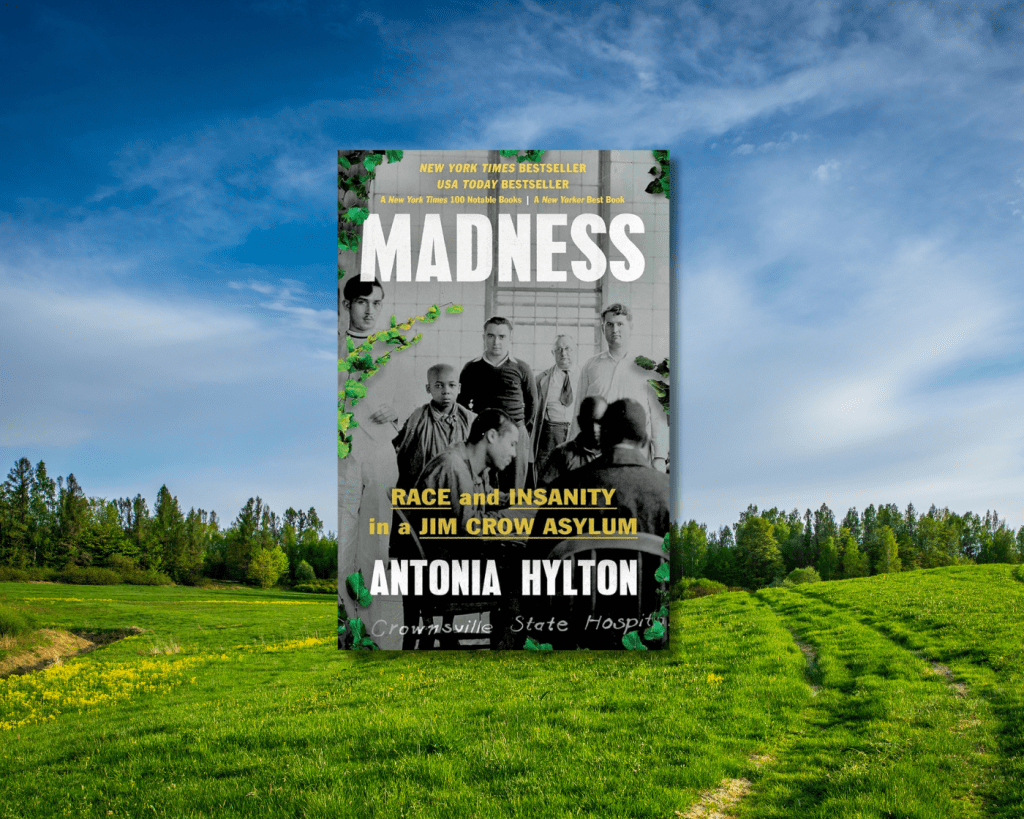
The land that Crownsville sits on is an important and frequent focus in Madness by Antonia Hylton, from the moment ground was broken for development to the future plans for that land today. Antonia Hylton writes about the land’s pain, its beauty, and the opportunities it provides for healing, community connections, and improved mental health. She delves into the wider history of Anne Arundel County land—sharing stories of oppression and gentrification, but also of healing and reclamation.
To annotate land stewardship and healing in Madness, you’ll need 24 tabs.
One tab will be for your tab key. I recommend choosing a pen or highlighter color that coordinates with your tab color, then highlight the sentences with land stewardship, use, and healing on each of the pages you tab. Page details below.
TAB INTRODUCTION, p 1
HIGHLIGHT and/or UNDERLINE:
- “I have come to this park with my loved one many times before.
- “Does every family…have a place like this?”
TAB Ch 3, p 47
HIGHLIGHT and/or UNDERLINE:
- “A Family in the Forest.” (section title)
TAB Ch 3, p 49
HIGHLIGHT and/or UNDERLINE:
- “Boy, if this field could talk.”
TAB Ch 3, p 51
HIGHLIGHT and/or UNDERLINE:
- “In her earliest memories, Faye says she was seeing colors. Later she learned to call them auras. They started out as flashing lights, deep reds and pinks in the forest where she used to play.”
TAB Ch 3, p 52
HIGHLIGHT and/or UNDERLINE:
- “…but in the outdoors Faye was convinced she was lucky and free.”
- “Sherwood Forest had always been her comfort. It seemed to want to reassure her that she could walk another path.”
TAB Ch 11, p 152
HIGHLIGHT and/or UNDERLINE:
- “One day, he strolled into work announcing: Marie, you got your wish. You can take the patients outside.’ Before he could change his mind, Marie rounded up as many patients as possible. The men walked slowly out into a courtyard enclosed by a chain-link fence.
- “One patient, a man named Mr. Bell, walked through the doorway and into the open space. Mr. Bell stood still. With Marie at his side, he tilted his head all the way back and looked up in awe. ‘I’ll be goddamned,’ he whispered, ‘there’s the sky.’”
TAB Ch 8, p 118
HIGHLIGHT and/or UNDERLINE:
- “When they returned from the trips, Thomas made it his priority to write reports for the administration, detailing the emotional and mental progress each participant had made in the outdoors.”
TAB Ch 11, p 153
HIGHLIGHT and/or UNDERLINE:
- “More than sixty years after she helped Mr. Bell see the sky again…”
TAB Ch 5, p 73
HIGHLIGHT and/or UNDERLINE:
- “At times, he has reminded me to go enjoy the outdoors, and he lets me know when his flowers are about to bloom.”
TAB Ch 8, p 115-116
HIGHLIGHT and/or UNDERLINE:
- “He loved to garden and make improvements to Crownsville’s property, and he’d walkaround and strike up casual conversations with the staff. When snowstorms came, hewould get out on a tractor and clear roads by himself or deliver food to the dorms on foot. It caught some of the Black nurses off guard in a good way. They felt like he cared about them and wanted the patients to live somewhere beautiful.”
TAB Ch 14, p 209
HIGHLIGHT and/or UNDERLINE:
- “She found Clarence shaking and chattering alone on the road, screaming to someone in the sky.”
TAB Ch 11, p 159
HIGHLIGHT and/or UNDERLINE:
- “All of the beauty of a summer in Maryland belied a painful, precarious truth. Summer fun was segrated.”
TAB Ch 11, p 160
HIGHLIGHT and/or UNDERLINE:
- “Any holiday or clear-skies forecast was a good enough reason to convene in a friend’s or family member’s backyard.”
TAB Ch 14, p 203
HIGHLIGHT and/or UNDERLINE:
- “Screaming at the Sky” (the chapter title)
TAB Ch 16, p 243
HIGHLIGHT and/or UNDERLINE:
- “His brother talked with her about how the man left Maryland for Vietnam and came home an alien in his own land.”
- “He explained how, worst of all, his brother didn’t realize that in spraying a foreign people’s land to death, he had killed himself.”
TAB Ch 17, p 256
HIGHLIGHT and/or UNDERLINE:
- “Black Annapolitans were being pushed off their land and out of their homes and moved into urban centers and public housing. In Maryland, you can often trace the story of Black families by looking at the water.”
TAB Ch 18, p 280
HIGHLIGHT and/or UNDERLINE:
- “The residents of that neighborhood had already been pushed away from the water and downtown Annapolis land. Allen had gone to the mat for them, and lobbied to ensure they were not dispossessed again.”
TAB Ch 20, p 294
HIGHLIGHT and/or UNDERLINE:
- “They never dug or disturbed the land.”
TAB Ch 20, p 296
HIGHLIGHT and/or UNDERLINE:
- “To him, Annapolis represented every stolen chance and buried secret in the county.‘All of it. It’s like what if—what if after slavery had ended, there was truly some semblance of reparations, not necessarily the way we look at reparations now, but what if we had just gotten forty acres and a mule? What if we and our farmers had continued to own their land? What if people were able to prosper? What would our culture look like today? Instead of that, I met Crownsville and I’m at this place with these people.’”
TAB Ch 20, p 304-5
HIGHLIGHT and/or UNDERLINE:
- “The next time patients returned to this open field, they arrived in handmade wooden coffins, carried through the trees by their fellow patients and employees. This was Crownsville’s birthplace, but for 1,722 of the hospital’s patients it became a final resting place.”
- “But you cannot outrun pain. It will creep down the branches of your family tree until it finds someone who is tiring of the sprint. It will take hold of that person who is willing to acknowledge that it is there, and demand that they find their way back through the forest.”
- “He wasn’t the most emotional or sentimental of men, but he knew what was at risk—what this land meant to the people he’d served.”
- “…if he would help him clean, recover, and maintain the cemetery before someone else got their hands on it.”
TAB Ch 18, p 280
HIGHLIGHT and/or UNDERLINE:
- “The residents of that neighborhood had already been pushed away from the water and downtown Annapolis land. Allen had gone to the mat for them, and lobbied to ensure they were not dispossessed again.”
TAB Ch 20, p 294
HIGHLIGHT and/or UNDERLINE:
- “They never dug or disturbed the land.”
TAB Ch 20, p 296
HIGHLIGHT and/or UNDERLINE:
- “To him, Annapolis represented every stolen chance and buried secret in the county.‘All of it. It’s like what if—what if after slavery had ended, there was truly some semblance of reparations, not necessarily the way we look at reparations now, but what if we had just gotten forty acres and a mule? What if we and our farmers had continued to own their land? What if people were able to prosper? What would our culture look like today? Instead of that, I met Crownsville and I’m at this place with these people.’”
TAB Ch 20, p 304-5
HIGHLIGHT and/or UNDERLINE:
- “The next time patients returned to this open field, they arrived in handmade wooden coffins, carried through the trees by their fellow patients and employees. This was Crownsville’s birthplace, but for 1,722 of the hospital’s patients it became a final resting place.”
- “But you cannot outrun pain. It will creep down the branches of your family tree until it finds someone who is tiring of the sprint. It will take hold of that person who is willing to acknowledge that it is there, and demand that they find their way back through the forest.”
- “He wasn’t the most emotional or sentimental of men, but he knew what was at risk—what this land meant to the people he’d served.”
- “…if he would help him clean, recover, and maintain the cemetery before someone else got their hands on it.”
 Annotate With Sara