All The Persephone References I Encounter in Books ***continuously updated***
Persephone in Literary Fiction & Memoir
The Wilderness by Angela Flournoy
from 2018/Uptown, p 50:
“The highlight of this little park was a statue of Harriet Tubman, forever mid-stride, going toward freedom, or perhaps back to hell like Persephone, but with the goal of delivering more souls out of there.”
The Bluest Eye by Toni Morrison
Dr. Tracey L. Walters argues in her book African American Women and the Classicists Tradition: Black Women Writers from Wheatley to Morrison (Palgrave 2007) that Toni Morrison alludes to –and updates–the myth of Persephone in The Bluest Eye. I’ve included some of my favorite quotes from her book on this topic below:
from Chapter 4 “The Destruction and Reconstruction of Classical and Cultural Myth inToni Morrison’s Song of Solomon, Beloved, and The Bluest Eye“
from p 99, The Myth Revised for Black Girls in America
“African American women writers are constantly drawn to the Persephone and Demeter myth because the mythic themes of patri- archal dominance and female sexual oppression remain central to the Black female experience. In The Bluest Eye Toni Morrison’s recreation of the mythic narrative also highlights the theme of Black female victimization. But rather than focusing on the physical abuse of the Persephone character, Morrison, like Brooks1, underscores the significance of examining the psychological trauma experienced by young Black girls.”
from p 114, No Demeter Figure for Pecola
“And unlike the mythic Persephone or Pepita2, Pecola has no Demeter figure to rescue her. Similar to “In the Mecca,” Morrison’s rendition of the Persephone-Demeter myth rewrites the Homeric and Ovidian fairytale ending because in the real world, poor, Black girls who are kidnapped and raped seldom return home.”
from p 116-117 Pecola’s Abduction is Mental, Not Physical
“Unlike Persephone who is physically kidnapped, Pecola’s abduction is mental rather than physical. Pecola like many young Black girls becomes metaphorically abducted by the image of the white aesthetic.”
from p 118-119 Pecola’s “Pomegranate Seeds” Equivalents
“Pecola’s resolve is to digest whiteness. She achieves this by eating Mary Jane candy (the candy wrapper features a blonde blue-eyed girl) and frequently drinking from a cup that is stamped with a picture of child icon Shirley Temple.”
The Persephone Myth and The Dick and Jane Cultural Myth: I found this point in Dr. Walter’s book so eye opening too. From page 117: “In the Dick and Jane world the ideal American family is one with two well-behaved children who reside with their two very loving parents, a cat and dog, in a perfect home surrounded by a white picket fence. Morrison deconstructs this myth showing that a family so perfect exists for no one. Morrison presents the Dick and Jane story three times. Each successive telling of the story deviates from the first, thus reflecting the breakdown of this cultural myth and proving that those who attempt to duplicate this fictional family fail.”
Memorial Drive by Natasha Tretheway (memoir)
Natasha Tretheway discussed mythology a number of times in her memoir about her mother’s death. In Chapter 2: Terminus on page 72, the Persephone myth comes up.
“I know only that it is winter, and already the daffodils are blooming in Atlanta. I know that I have picked them for her, a handful of yellow narcissi — the flowers planted, in the myth of mother and daughter, to lure Persephone to her doom: kidnapping by the lord of the underworld. She picks a bright flower and the earth splits open beneath her, taking her into its dark throat.
It’s as though I had rewritten the myth passed the doom onto my mother as easily as I had handed her that rough bouquet of daffodils. That night, descending to work beneath the city, my mother was already entering an underworld from which she would never fully emerge.”
Memorial Drive by Natasha Thretheway, Chapter 2: Terminus on page 72
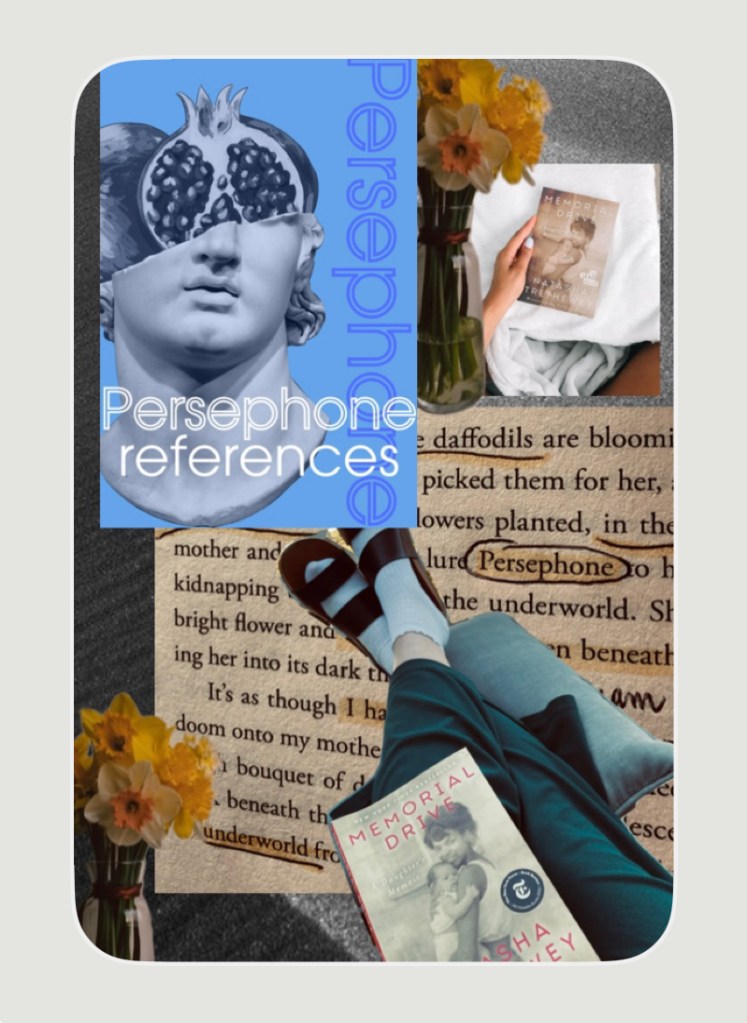
On Pinterest, you can save this reference. Click on the collage to pin it!
Persephone in Fantasy
Katabasis by R.F. Kuang
See Chapter 15, p 244
See Chapter 33, p 505
Persephone in Poetry
Build Yourself a Boat by Carmonghne Felix
I think that Felix light weaves Persephone myth imagery and themes into the entire collection. The only direct reference to the myth is in the poem “Tonya Harding’s Fur Coats,” where Demeter comes up twice. This Demeter naming, plus the collection’s repeated imagery of fruit, motherhood. and the seasons led me to draw this conclusion. There’s also an allusion to another Greek myth about rape: Leda and the Swan comes up in “Things the Block Taught Me.”
Persphone in Music
“Persephone” by Allison Russell
There’s a whole Substack post about this song! See: “Reception Radio: Persephone by Allison Russell” by Nina Houle
Read on Substack
Inspiration
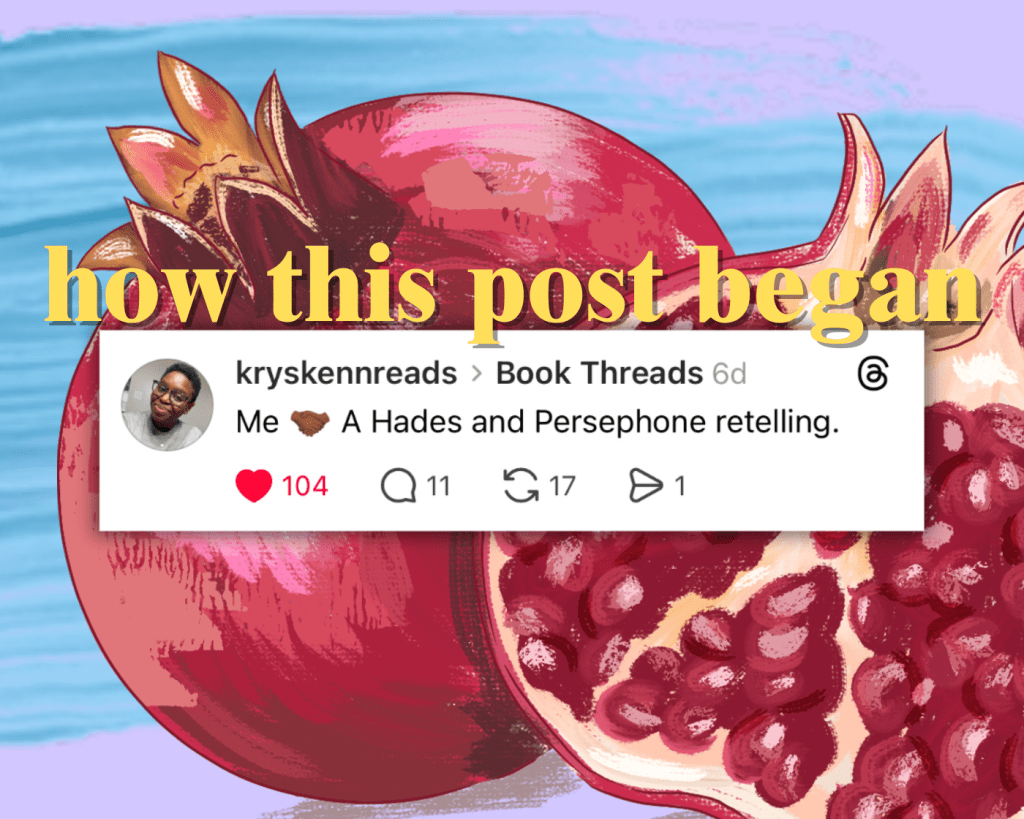
Like most things I write about books, this post started with me excitedly talking with a fellow reader on Book Threads. Krystina, who particularly adores Persephone myth retellings, periodically posts about it. I was so excited to see her latest post on the topic on Book Threads and immediately DM’d her about Dr. Tracey L. Walter’s Persephone-related interpretations of The Bluest Eye by Toni Morrison. Then, I got this idea to keep track of Persephone references I encounter on the blog!
 Annotate With Sara