
Let’s Start With A Random Olympic Tie In
Hoangmai H. Pham’s new memoir Bridge from Saigon has no direct connections with the 2026 Winter Olympics. But, in my mind, Bridge from Saigon unexpectedly continues a conversation about neuroplasticity that Olympian Eileen Gu started at an olympic press conference. Gu’s words for the press became the accidentally perfect introduction to my reading of Pham’s memoir because Gu, the most decorated olympic free skier of all time, also happens to be really good at carefully and tenderly analyzing her own mind. She is a lot like Pham in this way.
Gu and Pham both think a lot (and very deeply) about their thinking and how to shape their minds. Pham, in the memoir, calls her active introspection “self-editing.” Gu, during the olympics, described her thinking practice as “control.” For both women, introspectiveness is incredibly self-actualizing.
“You can control what you think. Like, you can control how you think and therefore you can control who you are. And especially as a young person, with neuroplasticity on my side, I can literally become exactly who I want to be. How cool is that? […] ”I’m always trying to modify. I’m trying to think how can I be better? How can I approach my own brain the way I approach my craft of free skiing, so I can be better tomorrow than I was today?”
– Eileen Gu, February 2026
About the Memoir
Bridge from Saigon is a complicated, beautiful refugee story. Geographically, the book takes place in Sài Gòn, Philadelphia, and Washington DC, but its main location is deep inside the author’s mind. Pham lives with dissociative identity disorder (multiple personality disorder), a mental health condition where a person has two or more interchangeable personalities. Pham’s disorder presents very differently than most cases. Hers is a high-functioning version, something her therapist Blue explains during the sessions Pham highlights often in the memoir. For most of Pham’s life, her separate personalities stay cocooned in her mind, mostly hidden from the outside world but very present and active within her.
Pham’s therapist Blue appears in almost every chapter. The way she interweaves his voice as direct dialogue in the chapter (usually in response to her narrative voice) was so compelling. I enjoyed seeing therapy on the page and the relationship they had.
The Artistic Structure
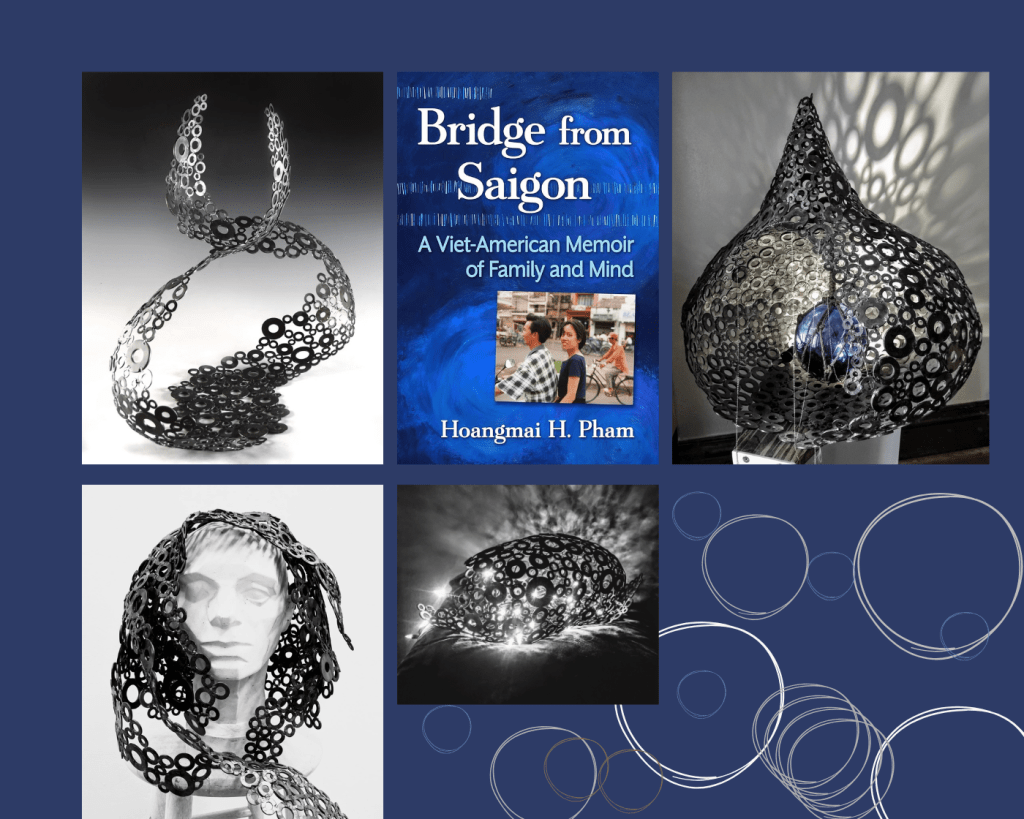
Bridge from Saigon reads fast. It’s crisp and tightly written. It has an unusual structure too. The length of the book is 235 pages, but there’s an astonishing number of chapters: 74 total! Pham very precisely fractured her memoir into numerous small, neat parts in a way that made me think of her art practice. On page 174 of the memoir, there are three photos of metal sculptures, all made by Pham out of hundreds of small steel washers. Tango, the first piece, is a double helix shaped sculpture that rises up. Treasure is gourd shaped with a small Japanese glass fishing buoy suspended inside. She Waited Until, the final piece pictured, is a winding scarf of steal washers that looks light and wispy wrapped around a mannequin head. To me, the multitudinous chapters are like the multitudinous washers in Pham’s sculptures. The chapters are small, neat, round, individual, and creatively fused together by Pham’s hands.
During Part 2, the number of short chapters can start to feel overwhelming. There’s a realization that there’s so many, and they’ll keep coming as if from a bottomless well. But, in retrospect, when I think about Pham’s visual art practice (something we don’t learn about until Part 3) envisioning the chapters as washers is really beautiful. It makes me regret my feeling of overwhelm in Part 2 because each piece in this memoir is necessary, just like each washer in a sculpture. When Part 3 rolls around and then Part 4, the shape of the book really comes together. Experiencing that coming together is very satisfying.
A Romance Novel Enthusiast’s Note on this Memoir’s Ending
Final note: I’m an avid romance novel reader. I love an HEA. This memoir’s ending unexpectedly delivered a romance-novel adjacent happy ending, or maybe it’s better to use a Vietnamese term Pham explains in the memoir: Hạnh phúc (Blessed Happiness).
Be sure to check out Hoangmai Pham’s visual art and scripture pieces on her website: https://www.maiphamart.com
Thank you McFarland Books, the future of agency LLC, and Hoangmai H. Pham for a gifted copy of this book.
 Annotate With Sara