Light Spoilers. The Curse of Hester Gardens by Tamika Thompson is out today in bookstores nationwide.
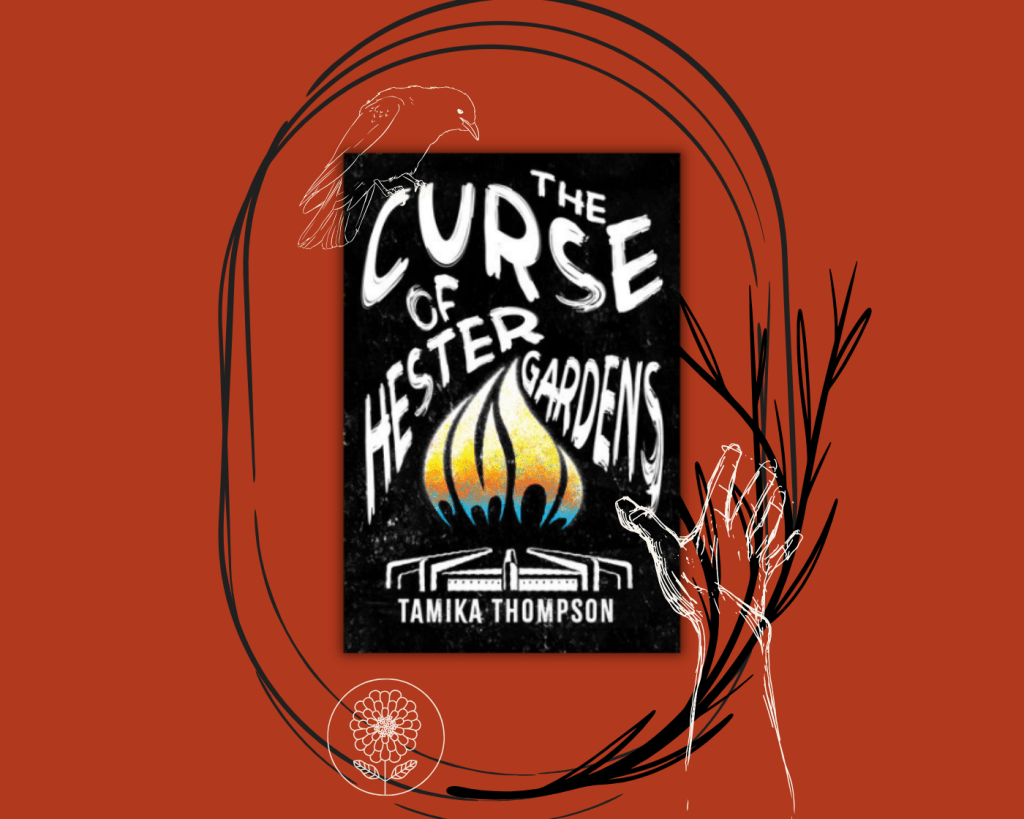
A Haunted House Story with a Twist and Shakespearean Elements
A lone wren swoops so low over Nona McKinley, the main character in The Curse of Hester Gardens, that she feels tiny wingbeats of air across her neck. It’s a fleeting and freaky detail, this wren in Tamika Thompson’s debut horror novel, and it’s the precursor to much grislier bird imagery in the scene. Nona is in the alley behind Hester Gardens, the public housing complex in Michigan where she lives. She feels the wren, then she sees her husband standing over a dying man, his “arms splayed like a downed bird.”
His name is NaDarius.
Nona’s husband Vance murdered him.
The wren in the prologue stuck with me, and it became one of the first bits of minutiae I linked to Macbeth.
The wren that flew by Nona is many things. It is a brief, barely noticed omen. It is a soft moment, the kind of thing readers can land on before entering a brutal murder scene.
The wren is also a symbolic messenger. The bird tells us who Nona is. Here’s where Shakespeare’s Macbeth comes in to help me decode the value of this wren’s symbolism. Nona is like the wren that Lady Macduff holds up as an example of a small, but mighty protector in Act 4, Scene 2 of the play:
“For the poor wren, / The most diminutive of birds, will fight, / Her young ones in her nest, against the owl.”
Nona is her family’s wren. The owls she’s up against: gun violence, poverty, ghosts, hauntings, and curses. She’s in a fight to save her two sons, Marcus and Lance. The scary thing is, there are a couple of owls that Nona is in denial about, ones she harbors and feeds in her own home, heart, and mind.
Books and art are always in conversation with each other, but it has been a while since a novel so vividly brought up Macbeth for me.
Dialogue, plot points, the vast cast members, and the supernatural are the elements in The Curse of Hester Gardens that my brain free associated with Macbeth by William Shakespeare. The parallels are big and small. The big include:
- The huge impact of one woman’s ambition.
- Hauntings, political violence, family, and revenge.
- Children being extremely vulnerable to (and sometimes pawns of) adult political machinations.
Macbeth parallel hunting became my odd personal reading obsession throughout The Curse of Hester Gardens and my solace. The Curse of Hester Gardens is so good, necessary, and quite evocative, but it is a very, very heavy story. (I wanted to cry a lot.) A Shakespearean side quest helped me read the novel deeper because searching for Macbeth parallels allowed me to stay intimately connected to Nona’s story while also metabolizing it in a controlled, structured way through this other story I knew extremely well.
Very Specific Parallels
1. “Shakespeare’s most child-obsessed play” and Thompson’s child-focused debut
The women at the center of The Curse of Hester Gardens and Macbeth are both grief-stricken mothers. This read of Lady Macbeth is not often focused on, but in the play there is a lot of quiet evidence1 that she lost a young child. Nona, a little differently, grieves an older child, her son Kendall who died at 18. Grief, for both characters, reshapes their entire lives.
Scholars, like Dr. Gemma Miller, interpret Lady Macbeth’s and her husband’s grief as part of their villain origin story: “The Macbeths are motivated to murder because they are grieving the loss of their child.”2 I wondered, after reading Dr. Miller’s insights, how Lady Macbeth might have been more like Nona had she two more sons to fight for. Would she have been a protector and not a murderer?
2. Murderous Secrets Between A Husband and Wife
Secret murders are significant to the plot of Macbeth and The Curse of Hester Gardens, and they are not carried out alone. Both stories feature a husband and wife in cahoots. Nona (who is a witness only) and Vance hold the secret of NaDarius’ murder close, never reporting it. Lady Macbeth and Macbeth similarly hold the truth about Duncan’s murder just as close too.
Guilt unravels both Nona and Lady Macbeth. For Nona, her understanding that NaDarius is another mother’s child weighs heavy on her like a curse. I thought of Nona while rereading Lady Macbeth’s famous sleepwalking scene, as her psyche crumbles under the heaviness of guilt. The murder of Lady MacDuff and her young son do not come up specifically in the scene, but it’s hard not to picture the child’s death weighing just as heavily on her mind as NaDarius’ does on Nona’s.
3. Local Setting Similarities
Hester Gardens is situated near a lake in Michigan and nearby another public housing community, the soon to be shuttered Dempsey Woods. I sensed some Macbethian equivalencies to Hester Gardens and Dempsey Woods .
- The Hester Gardens housing complex could be the equivalent to Dunsinane Hill. I very much consider Macbeth’s castle as a type of large housing complex too.
- Dempsey Woods and the Dempsey Boys are a territorial rival to Hester Gardens–a name and a rivalry that made me think of the role of Birnam Wood in Macbeth.
Interestingly, Dempsey Woods and Birnam Woods are used as shields in both stories. The Hester Boys (an active gang) conveniently hide behind the reputation of the Dempsey Woods boys (a defunct gang), blaming them for violence at Hester Gardens. In Macbeth, Scottish forces and the English Army do not hide behind reputations or blame a Birnam Wood gang, but they do famously hide behind the actual felled trees of Birnam Wood. Soldiers march as a moving forest, sneaking closer to Dunsinane Hill behind the cover of tree boughs that they hold.
Birnam Wood and Dempsey Woods are both destined for destruction in each story too. In Macbeth, Birnam Wood is razed, all its wild inhabitants forced to vacate. In The Curse of Hester Gardens, Dempsey Woods faces the same fate. It’s soon to be shuttered, all of its residents inhumanely displaced.
4. The Banquos of Hester Gardens
The spirits of people murdered at Macbeth’s castle and Hester Gardens do not move on. The spirits, trapped, haunt the living and the guilt ridden. Many of Hester Gardens’ lingering spirits are young and innocent, not Kings with targets on their back. There’s a a little boy with a blue ball, Nona’s oldest son Kendall, and an 8 year-old identical twin named Grace. More spirits join their ranks as the story unfolds, including a shadowy figure with glowing eyes that almost everyone at Hester Gardens can sense and see.
5. The Curse of Hester Gardens has a Shakespearean-Style Cast
While Nona’s story arc is central, just like Lady Macbeth’s in Macbeth, the novel’s cast is large in a very Shakespearean way. In addition to the ghosts, The Curse of Hester Gardens is stacked with dozens of secondary and minor characters, many with rich storylines and impactful scenes.
Thompson also delivers The Curse of Hester Gardens in a very Shakespearean format. Her novel contains five parts, which for me is very reminiscent of the five acts typical of a Shakespearean play.
The Shakespearean-esque Cast of The Curse of Hester Gardens by Tamika Thompson
*Main Characters*
Nona
Marcus
Lance
Mother Lincoln
Harlon
*Secondary Characters*
Peter
Paster Timothy Davis
Kendall
Vega
Mable
Vance
Donnell
*Minor Characters*
Jalani
Sister Taylor
Brother Taylor
NaDarius
Solomon
Sgt. Prager
911 Operator
First Lady Davis
Hester Boys
Dempsey Boys
Kiki
Gretchen
Kiandra
Cedrick
Baby Greyson
Several ghosts
I read The Curse of Hester Gardens with an eye for Macbeth parallels, in part, to give my brain an intellectual distraction. The novel is necessary, evocative, but very heavy. (I wanted to cry a lot.) Having a peripheral side quest of identifying Macbeth parallels gave me a way to slow down and really process the events and characters of this incredible book.
6. Foul Air
Both Macbeth and The Curse of Hester Gardens are smelly books. The witches at the opening of the play in Act 1, Scene 1 chant: “Fair is foul, and foul is fair: / Hover through the fog and filthy air.” Macbeth brings up foul air again as a sort of curse upon his approaching enemies in Act 4, Scene 1: “Infected be the air whereon they ride.”
The smell of uncollected garbage permeates the air at Hester Gardens and is frequently mentioned in the book.
7. Triple Repetition in Key Lines at the End
I love this coincidence of repetition and musicality in lines delivered in the final hours of both stories.
“Tomorrow, tomorrow, and tomorrow.” Macbeth utters these words in an Act 5 monologue about the futility of life in general.
“To bed, to bed, to bed.” This string of dialogue is what Lady Macbeth murmurs in a defeatist sentiment near the end of her life. It also occurs in Act 5.
“Ahead, ahead, ahead, Only ahead.” These are words are life advice and words of encouragement about the preciousness of life given to Nona twice. Nona hears them in Part 5 of the book. Then, she repeats them once to herself in a critical moment, where she is required to fight fiercely for herself and one of her sons. The words help them both live.
Read Deeply. Deeply. Deeply.
It’s a beautiful confluence to me that the endings of Macbeth and The Curse and Hester Gardens are connected through triple repetition. Tomorrow x 3, To bed x 3, Ahead x 3. Identifying this parallel is a bit esoteric, I admit. It’s definitely an example of how far I was willing to go to deeply compare these two works of art. You might wonder why I’d spend so much energy doing this. I think these efforts, this whole blog post as a matter of fact, are my personal way of urging others to read The Curse of Hester Gardens deeply–to please treat this novel like a Shakespearean play. Read it deeply for the interpersonal interactions, the machinations, the drama, and the individual lines of the book. There is a full Shakespearean tragic experience waiting for you in Thompson’s novel, along with the insightful wisps of hope and truth I think only a modern Black American horror author could offer us in this moment.
- In Act 1, Lady Macbeth says, “I have given suck and know / How tender ‘tis to love the babe that milks me.” ↩︎
- https://www.shakespearesglobe.com/discover/blogs-and-features/2023/07/04/the-children-of-macbeth/ ↩︎
 Annotate With Sara