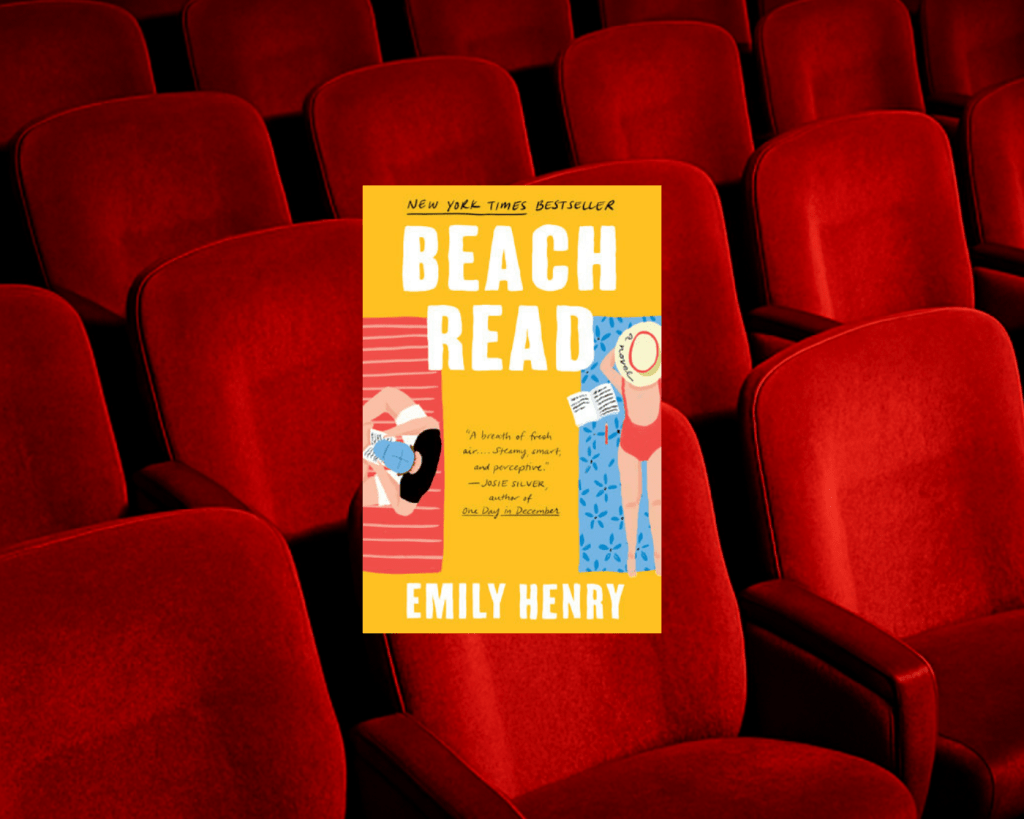
Readers are questioning today’s book adaptation news: Patrick Schwarzenegger has secured the starring role in the movie Beach Read, based off the book by Emily Henry. He will play Gus Everett, the elusive, grumpy, and rugged author who is in love with his neighbor and fellow author January Andrews. But can he pull this role off?
Director and screenwriter Yulin Kuang says he can. She cites his “electric” chemistry with co-star Phoebe Dynevor, explaining on Instagram that the selection criteria for Gus was not based on “the text.” The most important criteria was “who would play the best Gus opposite our specific January.”
I get this casting strategy, but it worries me. I wonder where else will the text be deprioritized in this movie and if we are on track to get a second disappointingly unfaithful Emily Henry adaptation. Netflix’s People We Meet on Vacation did not meet my expectations at all.
What if we are getting a different on-screen Gus Everett, like we got a different on-screen Alex Nilsen?
In the book, Gus Everett has dark messy hair with a little bit of gray coming in, olive skin, tattoos, dimples, dark eyes, a dented nose, and a crooked mouth. He is always a little disheveled and, at first, cautiously distant. He wears jeans, rumpled t-shirts, and sometimes has a “just-past-five-o’clock shadow.” He is lean, rugged, and smells like smoke plus the Indian fragrance blend nag champa.
With the right make up and styling, Patrick can probably pull of the “stupidly, infuriatingly attractive” but “not the universal kind of handsome that almost dulls itself with objectivity” that Gus exudes in the book. But it will be interesting to see if Patrick is even asked to do that. What if the rugged Byronic hero from the book is thrown out for something else, something softer? Truth be told, I picture Patrick playing the role of the golden boy of Jacques, January’s conventionally attractive ex-boyfriend and Gus Everett’s character foil. I guess as long as Gus Everett’s iconic line is not cut, I’ll be ok. I’m sure Patrick can’t mess up shakily uttering, “I feel overwhelmed that you exist.”
For now, here’s 15 quotes about Gus Everett’s look and style straight from the original text.
1. Curls.
“I took another sip of gin, then turned from the end of the deck and nearly yelped. On the deck ten feet to the right of mine, the back of a head of curly brown hair peeked over a lawn chair.” Chapter 1, page 10.
2. Tallish. Dark, messy hair.
“Technically, I didn’t see him now either. The porch light was a few feet behind and above him, transforming him into nothing but a tallish, person-shaped silhouette with a halo ringing his dark, messy hair. At this point, it would probably be better if I managed to go the whole summer without having to make eye contact with him anyway.” (Chapter 2, p X)
3. Olive skin. Prominent cheek bones. Messy, dark hair.
“Olive skin. Cheekbones that could cut you. Crooked mouth and a husky voice I’d never forget. Messy, dark hair I could immediately picture haloed in fluorescent light.” (Chapter 3, p 34)
4. Not the universal kind of handsome. Dented nose. Crooked mouth.
“To top things off, Gus Everett was stupidly, infuriatingly attractive. And not the universal kind of handsome that almost dulls itself with objectivity. It was more of a magnetism he emanated. Sure, he was just barely on the tall side of average, with the lean muscle of someone who never stopped moving around but also never intentionally exercised—a lazy kind of fit that came from genetics and restlessness rather than good habits—but it was more than that. It was the way he talked and moved, how he looked at things. Not, like, how he saw the world. Literally how he looked at things, his eyes seeming to darken and grow whenever he focused, his eyebrows furrowing over his dented nose. Not to mention his crooked mouth, which should’ve been outlawed.” (Chapter 4, p 37)
5. A bit of gray hair. Slightly disheveled. Five-o’clock shadow.
“I had to force myself to look directly at him. He looked just like he did in his author photo: all sharp cheekbones, furiously dark eyes, and the leanly muscled arms of a gravedigger turned novelist. He was wearing a rumpled blue (or faded black) T-shirt and rumpled dark blue (or faded black) jeans, and his hair had started streaking through with gray, along with the just-past-five-o’clock shadow around his crooked mouth.” (Chapter 4, p 37)
6. Dark eyes.
“I looked up to find Gus’s dark eyes burning into me. The effect was intimidating.” (Chapter 4, p 40)
7. Lean olive arms.
“Gus slumped against the booth and stretched his lean olive arms over his head, rolling his wrists to make them crack. “I don’t understand why there’d need to be a full genre that’s just books for women.” (Chapter 7, p 67)
8. Rumpled, dark t-shirt. Flat stomach. Sharp hip bones.
“I could vividly picture the curves of Gus’s arms as he tugged the shirt over his head, a flat length of stomach framed by the sharp angles of hip bones. He was a little softer than he’d been in college (not that it took much), but it suited him. Or maybe it just suited me.” (Chapter 9, p 85)
9. Not a golden boy like Jacques. Scars and ridges.
“Jacques had been handsome like an underwear model, perfectly toned with a winning smile and golden-brown hair that fell the same exact way every day. But it was all of Gus’s minor imperfections—his scars and ridges, crooked lines and sharp edges—and how they added up that had always made it hard for me to stop looking at him, and made me want to see more.” (Chapter 10, p 96)
10. Sexy, evil smirk. Smells like smoke and nag champa.
“Gus’s eyebrows lifted and his Sexy, Evil mouth went slack.” (Chapter 10, p 106)
“His Sexy, Evil mouth tightened.” (Chapter 10, p 106)
“Gus smelled smoky and sweet, like nag champa incense mixed with a salty beach. Jacques had blue eyes that twinkled over me like a summer breeze through chimes. Gus’s dark gaze bored into me like a corkscrew: What do I get?” Chapter 10, p 107)
11. Rumpled clothes. Veiny arms.
“Technically, I didn’t see him now either. The porch light was a few feet behind and above him, transforming him into nothing but a tallish, person-shaped silhouette with a halo ringing his dark, messy hair. At this point, it would probably be better if I managed to go the whole summer without having to make eye contact with him anyway.” (Chapter 11, p 113)
12. Hard lines and ridges.
“What do you weigh, Gus? Three beer cans, some bones, and a cigarette?” And all the hard lines and lean ridges of muscle I definitely hadn’t gawked at. “Any number of those painted animals could kill you with a sneeze.” (Chapter 11, p 122)
13. A tattoo.
“He looked over at me with a dark, fervent gaze that undid the careful composure I’d been rebuilding. My eyes slipped down him, and I scrambled for something to say. “What’s the big black blob about?” I tipped my chin toward the updated tattoo on the back of his bicep, where the skin was a bit paler than his usual olive.” (Chapter 18, p 200)
14. Tender, but rugged. Curved muscles. Rough hands.
“My hands skimmed down the curved muscle of his arms and knotted into his rough fingers. […]It was almost a whisper, a tender, rugged thing like Gus himself.” (Chapter 19, p 225)
15. Dimples, secret, singular, and elusive.
“The tangerine light glinted over his teeth when he smiled, deepening the shadows in his rarely seen dimples, and we stayed there, letting nothing happen all around us.” (Chapter 19, p 227)
“…and the light caught Gus’s face just right to reveal his secret dimple and lighten his eyes to a golden amber. Those eyes cut to me and his mild smile rose. He didn’t look like a different person. He looked more at ease, more sure, like all this time I’d only ever come face-to-face with his shadow.” (Chapter 21, p 258)
“As he swallowed, the dimple in his cheek appeared, then vanished from sight.” (Chapter 22, p 272)


