Gift Link to the Poem
“Literary Theory” by Ada Limón
This poem was first published online on FEBRUARY 8, 2026 on http://www.theatlantic.com. It also appeared in print in the MARCH 2026 issue of The Atlantic.
Hear Ada Limón Read “Literary Theory”
On April 8, 2026, Ada Limón read “Literary Theory” on The New York Times Book Review Podcast with Gilbert Cruz. You can listen and watch below or on Instagram.
A Synopsis of “Literary Theory” | What is it about?
Even though poems don’t have true plots, writing a synopsis for a poem is my go-to starting point for analysis. For “Literary Theory” by Ada Limón, I wrote a synopsis organized in three parts since the poem reads almost like a tiny, succinct personal essay with a beginning, middle, and end. It contains complete sentences too (four to be exact).
Synopsis of Lines 1-10:
An unnamed speaker tells us about her* own experiences with language via a first-person point of view. She* ponders the word “swallow,” noting how it’s a marsupial word and a homonym.
*For the purposes of this blog post, I’m choosing to use the pronouns she/her, though gender is never explicitly stated.
Synopsis of Lines 11-18:
The speaker used to lament the confusing, homonymic nature of words like “swallow.” Now, she just accepts language’s “brutish” trickery.
The past tense of “thought” and “knew,” along with the use of “once,” in this section is really important to notice. All her hard feelings toward language is in the past.
In this section, she explains that homonyms taught her a good lesson. Their multifaceted meanings kept her from being able to “say the right thing / in the right way.” I read that last bit with perfectionism in mind. She was miffed that homonyms could force her to stoop to crude nonverbal communication measures to get a point across. With “swallow,” she can “Blink twice” if she means the bird or “blink once” if she means ingesting food.
This blinking technique is a little silly, funny, and excessive like the poem’s wonderfully ostentatious title.
Synopsis Lines 18-25:
The speaker takes on a defeatist tone as she continues the poem: “Who / knows what we are doing…” These are words of acceptance. Language can’t be controlled, so she doesn’t try to anymore. She accepts the days when she feels grounded and “held together / by definitions.” (I picture her with a dictionary on her desk on these days.) She equally accepts the days when language is unpredictable and does unpredictable things to her mind. She tells us about the days when she reads “swallow” and neither of its definitions matters to her. Instead, what matters is the word’s transformational magic, which makes her “feathers show.” There’s a lightness in her imagination, a sense of her thoughts breaking free, at the end of the poem.
How I Read the Title “Literary Theory”
“I wanted to give it a really obnoxious title. So, I called it ‘Literary Theory’.” – Ada Limón introducing her poem “Literary Theory” on the New York Times “Book Review” podcast on April 8, 2026
“Literary Theory” is an ostentatious title for a poem. Curiously, the speaker didn’t specify any type of literary theory. She left the school of thought wide open. She could have titled this poem “Feminist Literary Theory” or “Queer Literary Theory” or “Post-Modernist Literary Theory” but she chose to be unspecific. This choice is odd for this particular speaker, who reveals herself in the poem to be thoughtful, thorough, and exacting.
Yet, there is one more instance of the speaker using broad generalization in this poem. She repeats the word “some” four times in twenty-five lines. Repetition is often a tool for emphasis. So, I wondered, What is she trying emphasize and draw my attention to by repeating the word “some”? I thought of two things:
(1) “Some” is another double-edged word like “swallow.” It’s a homophone. Just hearing the word, you could become quite mistaken. Is it “some” or “sum”?
(2) The word may also explain the unspecified nature of the title. We know there is some type of literary theory at play here in the poem, and it kind of depends on the individual reader. The speaker does not know us, and maybe she didn’t want to influence our thinking by naming some specific school of thought.
Maybe the infinite possibilities contained in a word like “some” is part of the point made with the repetition too. There’s an infinite possibility of readers, each with unique analytical lenses, who might find this poem. To go back to the speaker’s very first lines, I think she wanted to “allow” her readers to decide for themselves what the best way to “swallow” this poem would be.
Arrangement & Repetition Within the Poem
One of the first things I annotated in this poem was this pattern of vertically stacked word repetition. Look closely at the purple highlights in the graphic below, which marks every time this happens.
This stacking of these words could be entirely coincidental, but I sense deliberateness in it, a careful commitment to visual word arrangement and alignment.
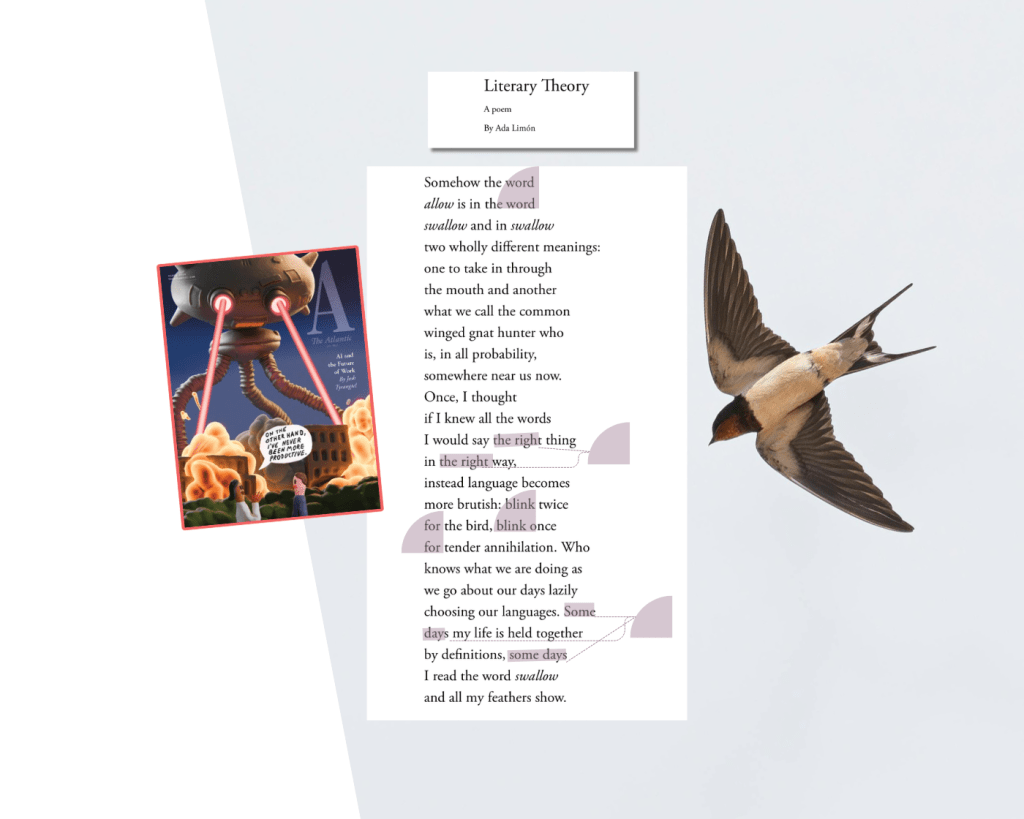
There’s a few other examples of interesting and intricate vertical positioning of repetition. The fourth and fifth lines of the poem begin with “two” and “one,” respectively. The sixteenth and seventeenth lines end with “twice” and “once,” respectively. The speaker takes great care with her line breaks to accomplish this stacking of “two” over “one” and “twice” over “once”. Again, she is deliberate.
Leaving Gnats for Literary Gnat Hunters to Catch
Knowing we are likely thinking about literary theory and hunting for things in the poem to analyze, I think the speaker leaves lots of things for us to catch. We are like literary swallows, aka the “winged gnat hunter(s)” which she mentions in the poem. As a literary swallow, I really enjoyed hunting down the gnats of repetition. Another one of my favorite repetitions is two occurrences of the words “is in.” The word pair appears in the second line of the poem as “is in” and then appears again as the result of a really odd and conspicuous line break. Line 8 abruptly ends with “who.” Line 9 picks up Line 8’s incomplete phrase and disjointedly begins with “is, in.”
“winged gnat hunter who
is, in all probability,”
Another nugget to catch is inside the very words “winged gnat” which puts “ng” and “gn” nearly side be side. It’s an odd, but pretty arrangement of letters. In this poem that’s partly about birds, the hidden symmetry of “ng…gn” reminds me of wings.
The Violence of Literary Theory
Diction reveals an inherent violence in “Literary Theory.” Harsh words like “take,” “hunter,” “brutish,” and “annihilation” speckle the poem. The words make me think about actual literary theory being violent. To dissect and analyze something like a poem, you have to cut it open to look inside and see what “feathers show.”
The Knowhow of “How” Appearing in the First Line and Last Line
There’s a cute cleverness with the word “how” hiding in the first line and the last line of the poem. “How” is ensconced within two separate words, “somehow” and “show.” This ensconcing is just like how “the word / allow is in the word / swallow.” This sleight of hand with “how” is a suave reminder that how we read a work from start to finish matters. There is meaning and joy hiding in plain sight. That’s the power of literary analysis.
You can support Ada Limón’s poetry and writing by purchasing her new book Against Breaking: On the Power of Poetry. Ada Limón spoke about this book recently with Traci Thomas on Ep. 420 of The Stacks Podcast.
Listen here: https://www.thestackspodcast.com/2026/4/15/ep-420-ada-limon
If you’re interested in supporting my work, please share this blog post on social media or pin this post to a Pinterest board! I also have an Etsy shop with annotating guides available for purchase as digital downloads.

