SPOILER WARNING: ending discussed
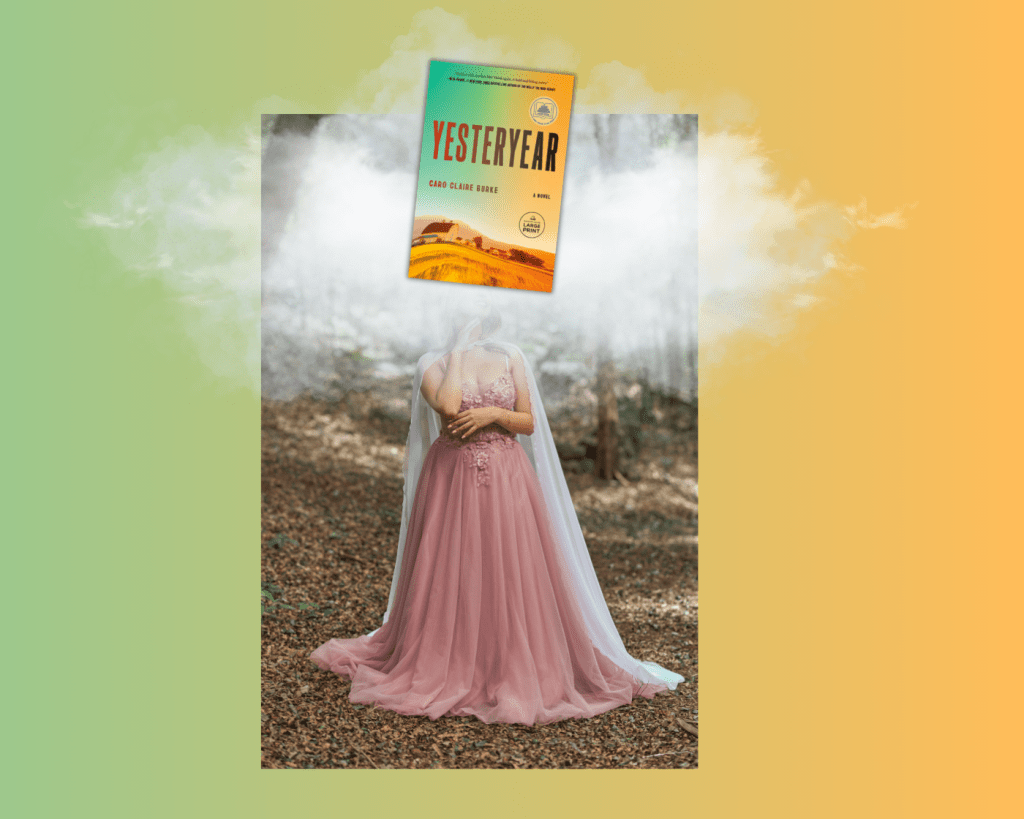
Is Yesteryear Well Written? Can a closer look at the fairytale motif answer that question for us?
Fairy tales are part of our collective imagination, and Caro Claire Burke draws on the power of fairy tales by including over 30 fairytale details in her novel Yesteryear.
On the surface, the fairytale stuff is a nod to what goes on every day on social media. Content creators (like Yesteryear‘s Natalie) spin far-fetched, magical tales about their lives, offering make-believe stories and illusions that tap into our imagination, wonder, and ire.
MAJOR SPOILERS BELOW
When I finished the book, I took a close look at the 30+fairytale details Caro Claire Burke left throughout the story and how they functioned in the text. I pictured them as Hansel’s and Gretel’s breadcrumbs, a literary device that served as a pretty decent navigation tool within the book. Unlike the breadcrumbs Hansel and Gretel tossed out, the fairytale breadcrumbs in Yesteryear last. They didn’t get gobbled up by birds, and I followed them to some pretty interesting conclusions.
The Trick of The Premise
Like most readers, I came to Yesteryear via its great premise. Once up on a time, a modern-day woman finds herself transported back in time. The setup teases the possibility of magic or science fiction, which put me in a fantastical, willing-to-suspend-my-disbelief headspace. Turns out, I trusted Caro Claire Burke too readily.
The premise was a delicious, dirty trick, like accepting one of the White Witch’s Turkish Delights. Like tasting a lotus flower from the isle of the Lotus-Eaters. That first bite was the trap, and it duped me for hundreds of pages. Oh, how I felt sick when I figured out my mistake! It occurred to me that the White Witch-style trick of the premise might be the point in part because it ties in eerily with Caleb drugging Natalie to control her. Because Natalie never time travels. She’s medically abused by Caleb, who is essentially the White Witch of this story. He doses Natalie with narcotics, imprisoning her in their adult version of a Narnia.
Children’s Fates in Fairytales – How the Fairytale Motif Helped Me Think About Children in Yesteryear
The fairytale details offer an interesting lens for the story, when it comes to the kids of Yesteryear. Picturing Yesteryear in the conjunction with of Grimms’ fairytales or The Chronicles of Narnia, for example, allowed me think about how often children in those tales escape in the end. The kids in Yesteryear break free of Natalie and Caleb, just like Hansel and Gretel eventually outsmart the witch in the woods and Edmund Pevensie grows up to be King Edmund The Just. No kid lives happily ever after and unscathed in any of these stories, but they do live free.
The Snow White Allusions
Interestingly, one of Grimms’ fairy tales that is directly alluded to in Yesteryear several times–Snow White and The Seven Dwarves– is a really an apt choice. The parallels this one offers are uncannily good. Snow White, like Natalie, is hiding from the Angry Woman figure by living off the grid in the woods. Natalie’s obsessive relationship with Reena eerily is in parallel with the Queen’s obsession with Snow White. There’s a mirror motif in Yesteryear too.
The Wizard of Oz Allusion in Chapter 8
The most helpful fairytale reference in the motif is to a uniquely American fairy tale: The Wonderful Wizard of Oz by Frank Baum. This reference comes at the end of Chapter 8, and it’s one that helped me picture Caro Claire Burke less like the White Witch offering a Turkish Delight of a premise and more like the trickster or illusionist that the The Wizard of Oz was. In this scenario, I felt more like Toto unexpectedly bumping into the screen that obscures the wizard or like a citizen of The Emerald City after the screen tumbles down. I was unprepared (and pissed) to see the true Yesteryear, but ultimately glad not to be under its illusion anymore. Yesteryear definitely didn’t give me the time-travel story I hoped for, but in its consistent little details – like the fairy tale elements – it is successfully giving me something else. I’m still not sure what that is yet, but I’m still having a good time figuring it out.
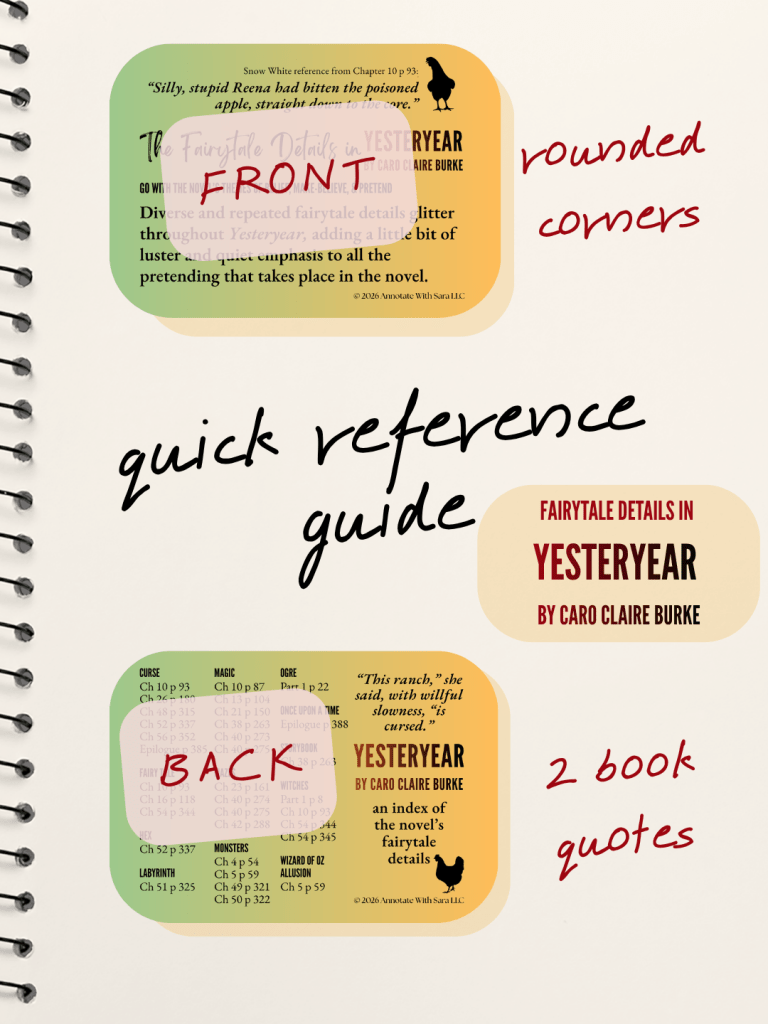
Want the complete list of fairytale details in Yesteryear? I have two Yesteryear companion products on Etsy with the details you need.
First, I have this quick reference guide that is 4.5″ x 5.5,” printed on glossy premium paper, and is ready to ship.
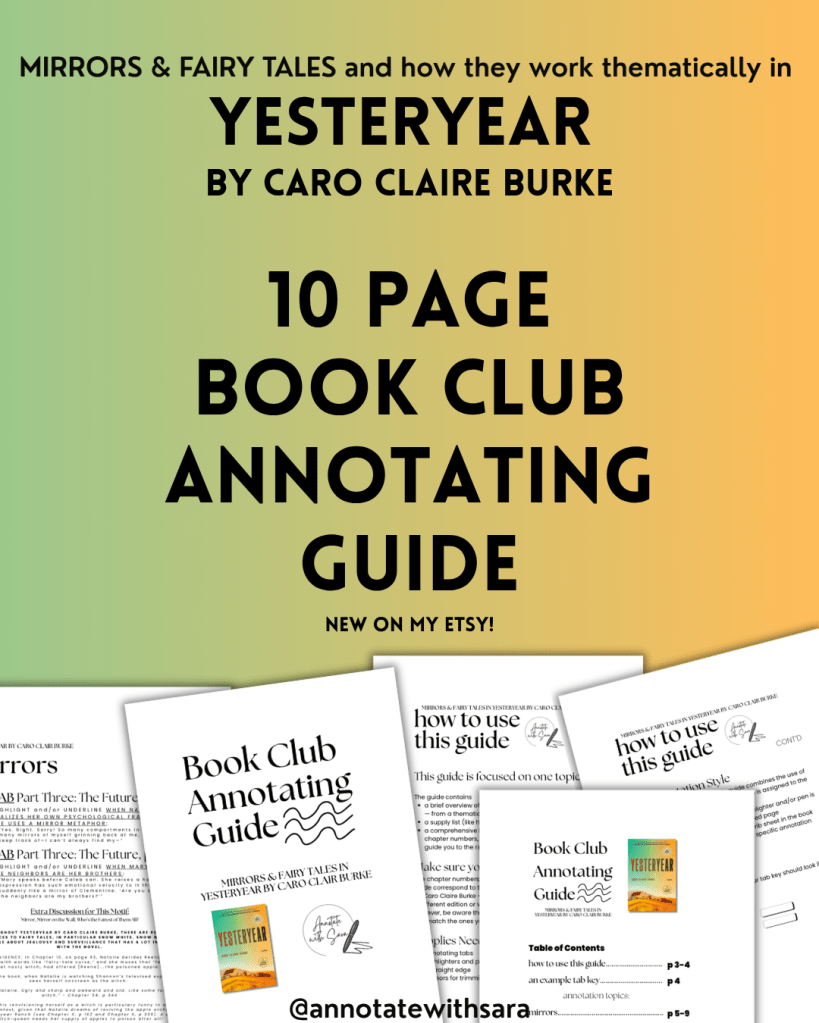
There’s printable index (in the style of a bookmark!) at the end of my digital annotating guide.

