Available on Aug 25, 2026 | 256 Pages | Knopf
Light spoilers occur when I discuss some motifs and imagery in the novel.
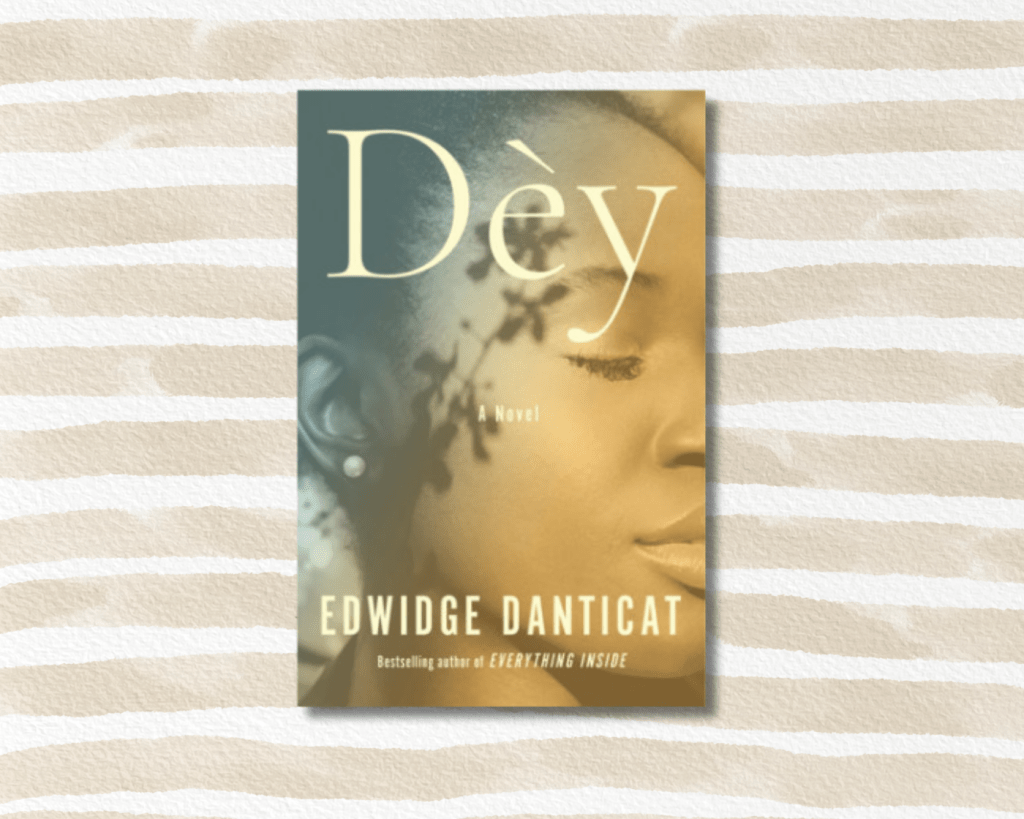
After a nail-biting first chapter, Dèy by Edwidge Danticat settles into an eerily quiet and placid novel, adopting a tone that’s like silence after a storm. The novel’s stillness reflects the shocked mental state of its main character, a 32-year-old Miami real-estate agent named Magnolia. In the nail-biting first chapter, she is shopping at a mall when a mass shooting occurs. Magnolia escapes the mall with her life, but leaves all her peace behind. The novel Dèy is a story about Magnolia finding her peace again.
While fleeing the mall, Magnolia leaves two objects behind: a bag and her sandals. As if her trauma and truth are tied to those objects, Magnolia decides to tell no one in her life that she was there at the mall. She hides from everyone that she almost died that day. Releasing her truth and getting her bag and shoes returned are entwined events. It is an unexpectedly beautiful microcosm of the novel that I mention in this review because I look forward to discussing it more with other readers. Once I have a final copy to quote from, I will deep dive how the truth, the bag, and the shoes are a trinity.
Dèy is set in 2018 and takes place over a few weeks’ time, starting with the mall shooting in late January and ending on Magnolia’s 33rd birthday, February 17, 2018. The story is rich with the past too. Magnolia, a grounded and reliable first person narrator, reflects often on her own memories, important dates, news events, and old family stories. The time periods and places covered by her memory are expansive.
Vertical imagery is something Danticat turns to repeatedly in the novel. Even geography (specifically of Haiti, Miami, and New York) is vertical to the characters. Trips to Haiti are trips “down,” making New York an “up” and Miami a “middle.” Other examples of vertical imagery include the mall escalator Magnolia rides on when the shooting begins, cavum clouds Magnolia’s 10-year-old daughter loves, deep underground caves her partner researches, chem trails the mass shooter fixates on, and, of course, the high-rise real estate Magnolia sells along Miami’s shoreline. Magnolia’s namesake, the Magnolia tree, ties her into all the novel’s vertical imagery as well. Like a tree, she’s connected to what’s above ground and under it. In fact, all of the novel’s high and low vertical imagery is within her reach. Her mind branches into the sky with the cavum clouds and chem trails and roots down deep in the ground with the caves that fascinate her partner. Magnolia is a firmly planted person, as her name suggests, but there’s also a sense that she’s trapped in place. The trauma of the shooting forces her to figure out if she can thrive where she is after all.
Water and photography are my favorite motifs in the novel. The water moments are quietly significant. Magnolia hides from the shooter at a mall restaurant named The Oasis and a large water fountain at the mall is a fixture in her memory from that day. A pool party marks a major turning point in the novel. Everywhere else, there’s a steady background presence of the ocean and its connection to both Miami and to Haiti, where Magnolia’s parents still live.
Photography, the novel’s other big motif, is Magnolia’s hobby, her comfort, and artistic calling. Through her, photography becomes so central to the novel, but it’s something that Danticat builds up slowly. In the beginning, the photography elements are ordinary: photos of Magnolia’s daughter Zoë in the foyer, the family photos she choreographs at a big family function. But photos anchor defining moments in the text too, especially between Magnolia and her mom. A texted photo of a rare magnolia tree and a framed photo on the wall of Haitian women sparks two separate family discussions, one in the present and one in the past, about family lore, mental health, and more. Magnolia’s interest in spirit photography is intriguing, as it is renewed by her own near brush with death at the mall. Photography has a big final, full circle moment at the end of the story. Echoing the moment in the foyer when Magnolia comes home after the shooting and looks at the photos of her daughter, there’s a similar moment at the end. Magnolia looks at new photos of Zoë, the ones she took at her birthday party, and in these photos she can finally see herself. The moment is exquisite and entirely enabled by a photo.
Water and photography are my favorite motifs in Edwidge Danticat’s new novel Dèy. For me, the deliberate and intricate photography motif was soothing, a reminder of the power of the art form and of photographic artifacts. I didn’t realize how much I needed to escape into a wholesome photography theme in a book until I read this. Undoubtedly because photography I interact with IRL is so rife with generative AI, it was just good to be with photography inside a novel that made it real, pivotal, and sacred.
Dëy can be read like a slow-release medicine, taken down all at once but allowed to react slowly and incrementally within the reader. It is a novel that, for me, was truly full of Toni Morrison’s concept of invisible ink. I think Danticat wants readers to look for the invisible, and that inkling comes from how she wrote Magnolia’s partner. His proclivities and priorities read like an invitation (and a clue!) to look at Dèy deeply because he is a character that finds what’s under the surface of things. He researches caves, which are full of secrets and never-before-seen things. He pursues knowing what lies deep inside his partner’s heart just as fervently too. Even though I don’t really need assurance to read a text written by Edwidge Danticat deeply, his character was a lovely nudging confirmation that doing so would reveal some wonders.

