SONG OF SOLOMON SPOILERS IN THIS POST
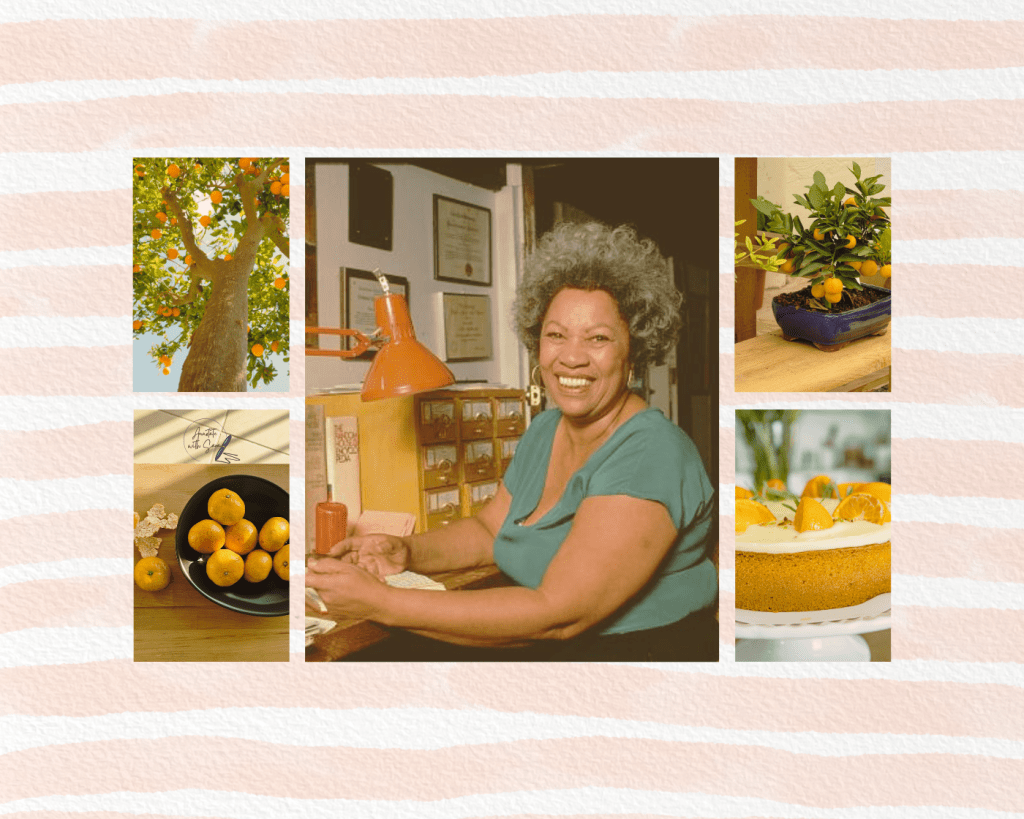
I have noticed a salient citrus detail, specifically oranges, in the novels Jazz, Tar Baby, Love, and Song of Solomon by Toni Morrison. There’s a very specific way that oranges seem to appear in each novel. The oranges are there when things get eerily still, often just after a character has experienced some duress. What’s more, the character is in a state of having either just arrived or just fled somewhere. Orange fruit operates like neon in the narratives of each of these novel, signs urging caution and warning of danger.
- In Jazz, Dorcas loses consciousness while looking at a bowl of Christmas oranges, the only decoration in the house. It’s the last thing she sees before dying. In a way, the bowl of orange brightness calms and anchors her as she passes.
- SEE PAGE 194 and 215 of JAZZ.
- In Tar Baby, Son escapes from a merchant ship. He then swims to a yacht where he stows away in a closet and finds an open crate with 12 potted orange trees inside. He eats every one of the bitter tiny oranges because he hasn’t eaten anything else in 24 hours.
- SEE PAGE 7 of TAR BABY, the end of the PROLOGUE.
- In Love, Christine remembers a road from the first time she ever ran away. The road she walked on smelled like orange blossoms for miles. She thinks of this smell several times in the novel. The blossom smell is in deep contrast to another repeatedly mentioned smell in the novel: the fishy odor from the cannery.
- SEE CH 3 p 59 and CH 4 p 81, 86, 94 of LOVE.
- In Song of Solomon, Pilate is peeling an orange on her porch steps when Guitar and Milkman approach her. This is the first time Milkman has met his aunt. She continues to meticulously peel the orange and break it into sections while she talks to them. As the scene evolves, it displays so many echoes with the final scene in the book. Pilate invites Guitar and Milkman in and ends up telling them stories of death: the story of Macon almost jumping to death (an echo of when Milkman flies in the last scene) and the story of her father dying from gunshot wounds (Pilate dies the same way). The scene foreshadows the ending, and the peeled orange is a neon warning sign.
- SEE CHAPTER 2 p 36, 37, 42 of SONG OF SOLOMON.
Deep Dive Another (Possible) Orange Scene in Song of Solomon
There might be another orange moment in Song of Solomon that operates in contrast to the scene with Milkman, Guitar, Pilate, and the fresh orange. It’s the sunshine cake scene in Chapter 1 on page 10. Nneka M. Okona writes in an article about remembering Toni Morrison through her food in Harper’s Bazaar1 that this cake was made “with either mandarins or crushed pineapple baked into the bater.” In this scene, which takes place in Milkman’s house when he’s a kid, the sunshine cake becomes a symbol of his lonely, disillusioned childhood full of “not peaceful” quiet. The sunshine cake and its oranges (I’m choosing to believe this is not the pineapple version.) is over-baked and very dry, a texture that’s symbolic. The dry, unsatisfying crumb mirrors all the unsatisfying, dry relationships Milkman has with everyone in his immediate family. He avoids his sisters, avoids his mom and her guests, and dreads the moment that his dad comes home. His future relationship with his Aunt Pilate on the other hand will be more like the juicy, fresh, and easy-to-peel orange she holds in the scene where he meets her for the first time.
You can read an excerpt of the sunshine-cake scene on Penguin Random House’s website: https://www.penguinrandomhouse.ca/books/117657/song-of-solomon-by-toni-morrison/9781400033423/excerpt
Check out this post on Instagram!
- quote from “Remembering Toni Morrison Through Her Food” by Nneka M. Okona in Harper’s Bazaar. https://www.harpersbazaar.com/culture/art-books-music/a61937519/toni-morrison-food/ ↩︎

