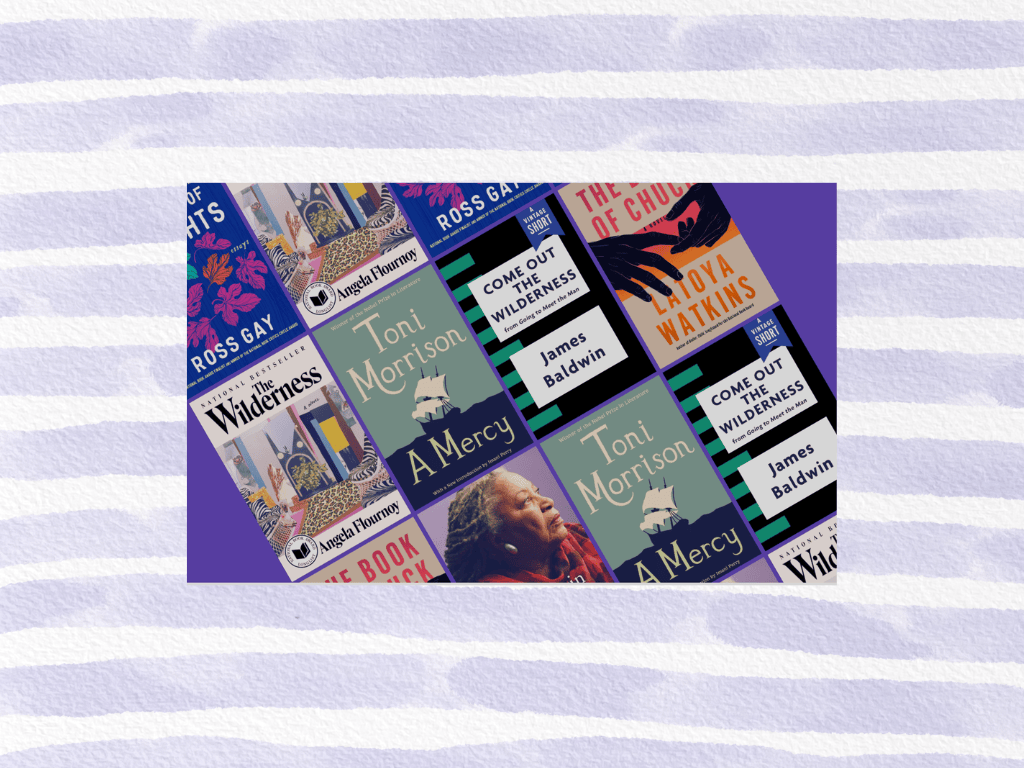
One of my favorite books from last year The Wilderness by Angela Flournoy is coming out in paperback this month. To celebrate, I’m publishing this post about wilderness metaphors, which have piqued my interest in the last year. I’ve started noticing wilderness metaphors everywhere, and I’ve been recording my observations. My list of books, poems, and short stories using various wilderness metaphors to describe human experiences is below.
The Wilderness Metaphor, An Overview
Wilderness metaphors, as I’ve encountered them so far, have to do with the vastness of human emotion, particularly the vastness of feelings like grief, loneliness, and sorrow. The metaphor makes sense. These feelings are dense like wilderness, uncharted like wilderness, and as easy to get lost in as wilderness is.
One of my favorite guiding wilderness metaphors comes from Toni Morrison, and she writes about exploring the wilderness of human emotion through reading. She writes in The Origin of Others:
“Narrative fiction provides a controlled wilderness, an opportunity to be and to become the Other. The stranger. With sympathy, clarity, and the risk of self-examination.” 1
My List: Literary Works with a Wilderness Metaphor
1. The Wilderness, a novel by Angela Flournoy, explores “the wilderness of adult life” and the “wounded wilderness” of wild spaces in Los Angeles.
On July 28, 2026, a few days after artist Betye Saar died, Angela Flournoy wrote a small tribute to Betye Saar on Instagram, explaining how her novel The Wilderness was inspired by one of her pieces of art called “The Wounded Wilderness.”
“For a long time my novel The Wilderness was actually titled The Wounded Wilderness, after this 1962 work of art by Betye Saar, who died at nearly 100 years a few days ago. For me The Wounded Wilderness is a perfect encapsulation of what it feels like to grow up amidst a world of constant, sometimes violent change. The goal is to keep bearing witness, to keep making art, like Betye Saar did for so long, both when the wider world was paying attention and when it wasn’t. May she rest in peace. “- Angela Flournoy on Instagram
2. In A Mercy a novel by TONI MORRISON Florens reclaims the idea of a wilderness as a beautiful thing within her.
Blacksmith first uses the metaphor of wilderness to insult, demean, and control Florens. Eventually Florens reclaims the metaphor for herself. The quotes from the novel and the page numbers are below.
“You are nothing but wilderness. No constraint. No mind.” – page 135
“I am nothing to you. You say I am wilderness. I am. Is that a tremble on your mouth, in your eye? Are you afraid? You should be.” – page 149
“See? You are correct. A minha mãe too. I am become wilderness but I am also Florens. In full. Unforgiven. Unforgiving. No ruth, my love. None. Hear me? Slave. Free. I last.” – page 153
3. The Book of Delights an essay collection by ROSS GAY introduces the idea of a “wilderness of sorrow.”
At the end of the July 25, 2019 episode of The On Being Project, Krista Tippet asks Ross Gay to read from The Book of Delights. To my delight, he reads from the end of the essay “14: ‘Joy Is Such A Human Madness,’” the very part of the book that introduces his metaphor about wilderness.
“And what if the wilderness — perhaps the densest wild in there — thickets, bogs, swamps, uncrossable ravines and rivers (have I made the metaphor clear?) — is our sorrow? – “14: ‘Joy Is Such A Human Madness,’” page 149
Is this, sorrow, of which our impending being no more might be the foundation, the great wilderness?
“Is sorrow the true wild?
“And if it is — and if we join them — your wild to mine — what’s that?
“For joining, too, is a kind of annihilation.
-from “14: ‘Joy Is Such A Human Madness,’” page 150
4. In “Wilderness,” a poem by CARL SANDBURG, wilderness is embodied, and it is a controlling force of all the animals inside the speaker.
There is a hog in me . . . a snout and a belly . . . a machinery for eating and grunting . . . a machinery for sleeping satisfied in the sun—I got this too from the wilderness and the wilderness will not let it go.
5. In”Come Out The Wilderness,” a short story by JAMES BALDWIN, the everyday “labor and sorrow” of life is a wilderness the characters are born into.
In this short story, the main character Ruth first thinks about wilderness because of the hymn her mother often hummed titled “Come Out The Wilderness.” For Ruth, life is wilderness of “everlasting, nagging, infinitesimal details,” a culmination of “nothing” that makes her question “how could [her mother] be singing still?”
In addition to listening to the hymn on YouTube, you can listen to the whole short story read out loud YouTube or read a concise summary of the story on Ebsco. I also wrote about annotating this short story back in January on my blog with a full annotating guide. The post is called: “Practice Annotating With A Short Story by James Baldwin“
6. In “Wilderness Lost” a poem by MAY SARTON, the wilderness lost is her beloved cat Bramble.
In this poem, May Sarton writes about the death of her cat Bramble as a wilderness lost. The opening line is:
“She was the wilderness in me”
7. In The Book of Chuck, a novel by LaToya Watkins, wilderness is a metaphor for the cult Lettie & Swan got lost in.
Baby says on page 232 (Part IV: 2014, Chapter 15) says”
“I’m ashamed that I once followed them into their wilderness.”
Later on page 256 (Part IV: 2014, Chapter 16) Lettie, Baby’s mother, reiterates the same idea of wilderness:
Of all the ghosts that haunted me to here, of all the ‘sorrys’ and repenting I said in my wilderness, this the thing that come back for me. I let Chuck come back to me after everything.”
You can shop all the books mentioned in this blog post in my Annotate With Sara Shop with Bookshop.org!
FOOTNOTES
- You can read a review of The Origin of Others (with the wilderness quote) by Lidija Haas here in The Guardian from October 2017. ↩︎
 Annotate With Sara