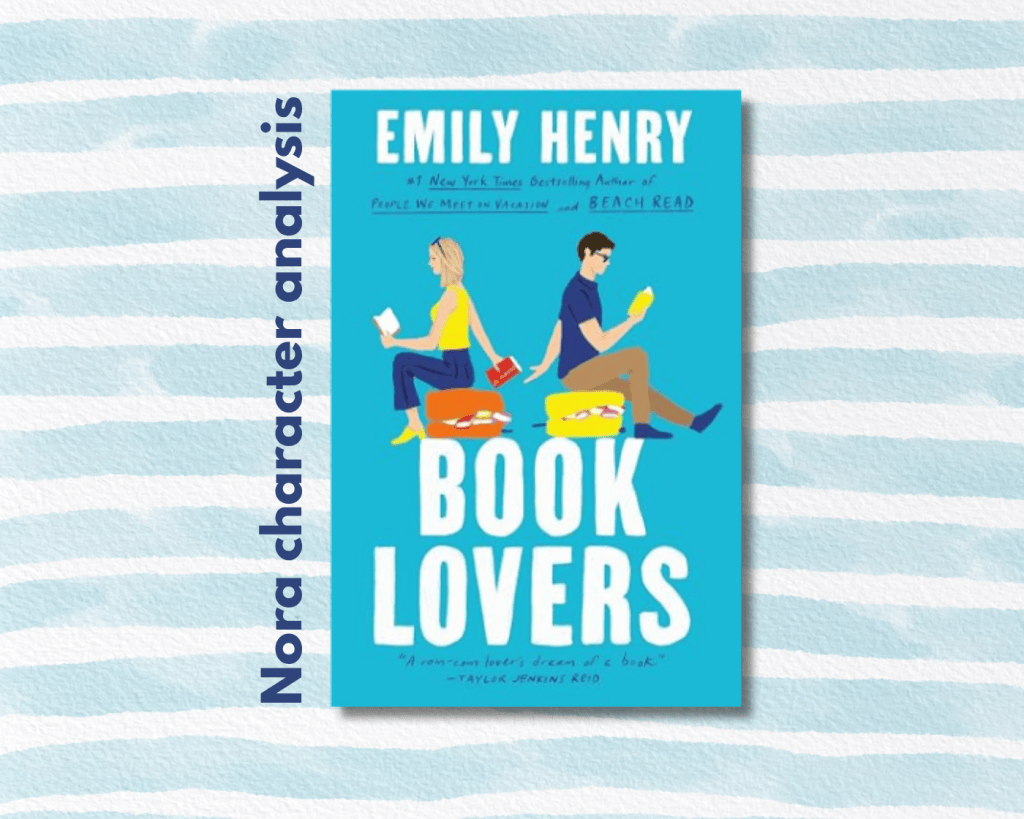
SPOILERS FOR BOOK LOVERS & LOOKING AT NORA AS A LITERARY GATEKEEPER
“So I guess I started to think about books more critically.”
– Nora from Book Lovers p 156
How The Romanticization of Wuthering Heights Gave Me Pause, Then Gave Me Answers
Nora Stephens, the main character of Book Lovers by Emily Henry, romanticizes Emily Bronte’s novel Wuthering Heights. On two separate occasions, she describes her love interest Charlie as a Heathcliff figure. He’s a “second-act Heathcliff” (p 11) in the beginning. He is worthy of the famous “I am Heathcliff”(p 301) line at the end. In between, she plays hard with the unlikable, morally questionable outsider characteristics that get assigned to the typical Byronic hero, the very characteristics which Wuthering Heights‘ Heathcliff popularized. In fact, she plays so much with these characteristics that Charlie becomes quite distorted as this devilish1, animalistic, ethnically-ambiguous (but white-presenting), Byronic hero of a man just like Heathcliff.
Nora participates in a selective reading of Heathcliff’s character and, much to my disappointment, fails to see (or talk about) how the language she uses exoticizes Charlie in problematic ways2. She indulges in describing Charlie with the tall, dark, and handsome allure of Heathcliff’s physicality and personality (he is a quintessential Byronic anti-hero), while omitting how this same character was met with discrimination, dehumanization, and scapegoating for being not white. Charlie shares Heathcliff’s outsiderness. He grew up feeling like he never belonged to his community of Sunshine Falls, NC.
How Nora’s Introspection Fails
As a powerful white woman in publishing and an educated and accomplished reader, I expected Nora (at some point) to notice her problematic language patterns toward Charlie and how she was borrowing much of that language from Wuthering Heights. I expected her to contend with (or at least think about critically one time) Wuthering Height’s themes of racism and ethnic discrimination and how they affect Heathcliff. Lastly, I expected her to acknowledge that she was indulging in the cliche of romanticizing Wuthering Heights even though she is fully aware of the book’s plot and themes. Done with care, that could have been interesting character growth for Nora.
Since Nora doesn’t do any of the above in Book Lovers, I began to read her character with a certain suspicion: that she might be a white woman in America who willfully ignores racial identity politics and racial privilege.
The Shift From Red-Flag to Evidence
A shift happened as I noticed more things about what Nora sees and does not see in the world around her. Her rosy reading of Wuthering Heights went from red-flag behavior to evidence for my character analysis because it became clear that Nora’s character thinks very little of race, ethnicity, and diversity in her real life and not just when it comes to this novel she loves. Her relationship to Wuthering Heights, though, gave me my first big set of questions:
- Nora, who positions herself as a trope expert in the prologue, never notices the problematic ways in which she exoticizes Charlie using tenets of the “tall, dark, and handsome” Byronic anti-hero trope. Why doesn’t she notice how far she leans into the wild, satanic, animalistic tenets that have marred this trope? Marred it because this language has been used, alongside the Byronic hero trope, to perpetuate the idea of a dangerous, primitive, irrational, and violent not-white Other.3
- Nora never names the famous Byronic hero trope outright4, despite enjoying talking about Heathcliff and plenty of other tropes that appear in her real life. (Re: Nora is a character who chooses to capitalize tropes as proper nouns in the text.) The closest she gets is when she calls Charlie “the Rake of Main Street” on p 136 and a “Metropolitan vampire” on p 7. It’s close because the rake trope was a precursor to the broody Byronic hero, and vampires, like a lot of characters with satanic leanings, are often considered Byronic heroes.)
- Is Nora’s refusal to have deeper conversations about Wuthering Heights and the Byronic hero trope in her own story the tip of the iceberg for her behavior?
“Tropes and clichés have to come from somewhere, right?” I say. “Women like me have clearly always existed. So it’s either a very specific kind of self-sabotage or an ancient curse. Come to think of it, maybe it started with Lilith. Too weird to be coincidence.”
– Nora from Book Lovers p 95 on archetypes and tropes
What if Charlie sensed Nora’s exoticization of his “dark features”?
Nora, who is introspective about tropes in this book, somehow doesn’t catch herself repeatedly lauding and making fun of Charlie’s “dark features.”5 She doesn’t look back and reflect on the problematic ways she paints Charlie as animalistic, wild, and supernatural, especially when, in nearly the same breath, she will look at Charlie’s blond-haired, green-eyed cousin Shepard as a literal child of the Greek Gods (she calls him Adonis several times). She never stops to think about the othering nature (sometimes belittling nature) of the language she uses to describe Charlie.
A reach possibly, I wondered if Charlie sensed Nora’s proclivities, her weird focus on his “dark features6“, eyebrows, golden skin, and color-changing yellow eyes, and that’s why he kept details about his biological father close to his chest when he told her that the man who raised him is not related to him by blood. In this pivotal scene, he reveals almost nothing about his biological father’s identity to Nora, except that his mom met him in New York7. Given Nora’s track record in the text (I’m thinking of that weird scene when she flat-out ignores Charlie after he shares that an Octavia E. Butler book changed his life on p 151.8), perhaps he knew she’d be weird about finding out details about his biological dad, especially if his dad isn’t white.
Nora Talks About Everything But Not Race & Ethnicity IRL, So What Is She Like At Work?
Race and ethnicity are just about the only things that Nora is conspicuously oblivious to as the introspective protagonist-narrator of Book Lovers by Emily Henry. I describe it as conspicuous because she is fluent and comfortable with a repertoire of related topics, like classism, nepotism (p 5), and sexism. For systemic racism not to come up at all, even though she is American and the novel’s primary action takes place in the rural American South, felt deliberately off. How strange that, with the exception of two musicians and three authors, Nora does not mention any Black people in the novel or any other people of color in the communities she’s in. How curious that she does closely regard all the blond hair, golden skin, and blue/green eyes that cross her path.9 She also makes careful, internal observations about skin tones and hair textures of white characters.10
Nora noticing only whiteness made me wonder:
- Is Sunshine Falls, NC a monocultural11, rural, and small Southern town with only white people?
- She is from NYC, and she is stuck in a small, provincial town. Does she miss the multiculturalism of New York City? If so, why doesn’t she talk about it?
- Is Nora an “I don’t see color” type of person?
- Does Nora belong to a diverse community in NYC?
All the Above Leads Me to This Question: What kind of literary gatekeeper has Nora been throughout her career?
All in all, Nora seems to be a narrator who has no thoughts or observations to share about racial and ethnic diversity: As a powerful white woman in publishing, that’s a problem, but not a typical character flaw that is discussed in online reviews and at book clubs. Do we think Nora, who isn’t noticing or thinking about DEI in her day-to-day life, and who characterizes her own love interest with problematic, exoticizing language, is in the practice of thinking about DEI and harmful rhetoric at her job? What kind of literary gatekeeper has Nora been throughout her career? Sadly, given how little she thinks of diversity presently, I think she probably has not strived to make sure stories written by authors of the global majority get fairly seen, get big deals, and get a lot of support from publishers. I’d like to be wrong, but I don’t think I am.
Reading Is Political: Did Emily Henry’s own concerns about diversity gaps in publishing, along with the publishing industry’s false commitments to DEI in 2020, affect how she created Nora?
Emily Henry published Book Lovers in 2022. It’s hard to find information online about when exactly she wrote and revised it, but her novel was certainly produced and finalized after the surge of DEI promises made by corporations across America in 2020. Did the political climate, plus Emily Henry’s own concerns about diversity gaps in publishing, and the publishing industry’s false commitments to DEI affect how she created Nora? I think so, and here is why:
First, she wrote Nora with immense power in publishing, but (as I’ve gone into depth above) did not write her as someone interested in diversity or anti-racism in her private life. Nora also never thought DEI was important enough to talk about professionally as she narrated, which makes Nora a snapshot of a certain kind of status quo: a publishing professional without a real commitment to racial equity and moving the needle.
Second, the people around Nora, namely Charlie and her sister Libby, are written a little differently than Nora. This comes out in their reading choices as fellow book lovers. Charlie cites an Octavia E. Butler book as life changing. Libby, like Emily Henry IRL, enjoys reading diversely and voraciously, especially within the Romance genre. She tells Nora a story about hiding from her kids to read a Rebekah Weatherspoon novel (p 125), and Libby influences Nora to read an Alyssa Cole romance that Nora ends up loving (p 207).
I have chosen to read Nora’s character as a statement about the state of publishing. Whether that is an intentional statement on Emily Henry’s part, I’d be so interested to know! But even if Nora’s character is the product of Emily Henry’s politics and her own concerns at the time seeping subconsciously into her writing, it would still be worth reading Nora this way too. My hunch, however, is Nora’s character was intentionally written the way I’ve interpreted her. In a sequel, if there ever is one, I think Libby would be the person that calls Nora in and pushes her to think about her privilege, her power, and her identity as a white woman in publishing. She would maybe help Nora redirect her very own words onto herself. “Now that I know what’s wrong, I can fix it.”12
FOOTNOTES
- p 98 ↩︎
- To Nora, he’s a “metropolitan vampire” (p 7) with “full lips” (p 7, 42, 43), “black hair” (p 7), and “dark features” (p 7). He is “some jungle cat” (p 11) or “Oscar the Grouch” (p 11). Then he’s a “jungle cat” again on page 161 and a “jungle cat” for the last time with this add on: “by some strange, ancient curse, a jaguar was turned into a man” (p 208). ↩︎
- thinking of Edward Said’s conceptual framework of the Other here ↩︎
- She does name the “Darcy trope” (p 231) the City Person trope (p 3), as well as many other tropes related to small-town romances and archetypical villains. ↩︎
- She calls him a muppet (p 11) and Groucho Marx (p 42). ↩︎
- “you said it not me” p 11; “When his gaze meets mine, it’s startlingly dark. It feels like I’ve stumbled toward the edge of something dangerous. And worse, like I’m trapped there in viscous honey, incapable of stepping back from the ledge.” p 153; Charlie’s yellowish eyes with “lightening strikes” (p 82, 120, 189) are demon-adjacent. ↩︎
- Book Quote from page 270: “My biological father’s an art curator, back in New York, actually. We’ve exchanged a couple emails, and that was enough for us. As far as I’m concerned, Clint’s the only dad I’ve ever had or needed, but as far back as I can remember, I knew I wasn’t like him. Didn’t look like him. Didn’t like the same things as him.” ↩︎
- This moment was so weird! Nora heard Charlie loud and clear. Why doesn’t Nora ask which Octavia E. Buttler book changed this man’s life? She has no filter around Charlie. Why isn’t she pestering him to find out what the book is? Kindred? Parable of the Sower? Why doesn’t she want to know? Charlie is a white-presenting man from the South who holds a book written by a Black woman dear. I’m interested in the book that changed his life, and I wish Nora had an ounce of interest in that scene too. ↩︎
- “Mediterranean sea-blue eyes…from dad’s gene pool” (p 16), Adonis (p 41, 60, 217), her own natural hair (not blond) she describes pejoratively as the color of “dirty dishwater”(p 64); talks about “natural color” (p 65) vs unnatural blond (p 2); “the blond demigod” (p p178); “blond behemoth of a man using a wheelchair…this woodsy, freewheeling waif” (p 212); “the green eyes, the blond hair, the beard” (p 262) ↩︎
- olive skin (p 134), golden skin (which she uses to describe Charlie on p 86, 119, 169), browned (from sun exposure) skin (p 259), coarse hair (p 41, 107, 141). “salt-and-pepper curls” (p 158). ↩︎
- Sunshine Falls is just on the edge of Appalachia too, which I find really interesting she isn’t curious about at all. ↩︎
- p 254 ↩︎

