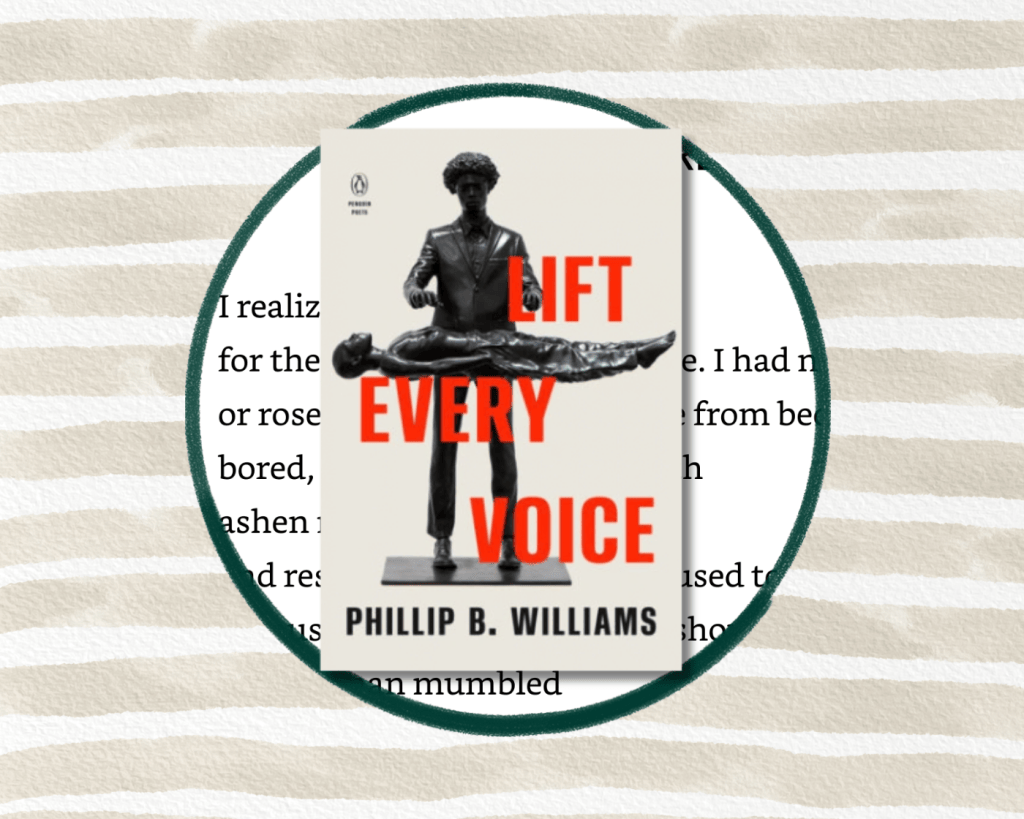
In Phillip B. Williams’ poetry collection LIFT EVERY VOICE, there are several poems linked to Toni Morrison’s novels. One of my most heavily annotated poems in the collection is one of the Morrison poems. It’s called “While Reading Sula.” You can find it on page 14 of the collection or you can read the 2024 version of the poem on the Poetry Foundation’s website (as it was published in the JULY/AUG 2024 issue of Poetry magazine).
Annotating poems is a delightful practice. It feels like creating art on the page. (I know writing in books is not for everyone, but is for me!) Annotating poetry is also a very necessary practice for me to understand poems, connect deeper with them, and see the designs and details that make poetry so enjoyable for me.
In this post, I want to show you how I annotated “While Reading Sula” by Phillip B. Williams. To see my annotations visually, please check out my instagram post below. There is an infographic for each type of annotation I did. If you keep going, the rest of the post has typed out descriptions of my annotations and reasons why I did them.
My Annotations for “While Reading Sula” by Phillip B. Williams
First off, I noted the poem’s 2024 to 2026 evolution. Willliams made two changes. The word “born” is now “borne,” and an em dash replaces a comma in the final line.
The poem pulls imagery straight from Toni Morrison’s novel Sula. So, of course, I went into that text looking for quotes! Here are the Sula quotes that informed my poem reading:
“It was a fine cry—loud and long—but it had no bottom and it had no top, just circles and circles of sorrow.”
– Toni Morrison in Sula (Ch 1965, p 174)
“…the meaning of the birthmark over her eye; it was not a stemmed rose, or a snake, it was Hannah’s ashes marking her from the very beginning.”
– Toni Morrison in Sula (Ch 1939, p 114)
What I highlighted as “straight from Sula” imagery in the poem:
- “I realized I was Nel and wept”
- “I had not borne snakes / or roses made of cinders.”
- “ashen”
- “Why should I burn”
- the em dashes in the last line
Next, I annotated the poems vertical language: “rose” + “beneath” + “above.” Vertical language is super important in Sula too. Think of Nel’s “circles and circles of sorrow” and “The Bottom.”
Sula and Nel are a pair. So, I thought it was really cool that most of the lines in Williams’ poem had sound pairs:
- I + I
- RO + RO
- ROSE + ROSE
- EN + EN
- RE TO + RE TO
- UZ + UZ
- and the deliberate double absence of sound made by the em dashes in the last line
Williams put “borne snakes” in one line and then a short while later morphed it ever so lightly into “bored, snaking” in another line. I LIVE for details like that in poetry!
There’s a pattern of church/Biblical imagery I wanted to highlight. The words I marked are: “snakes,” “snaking,” “votive,” “Christ,” and “sacred.” I include scared here because it is SO CLOSE to the word sacred.
There’s a lovely sound cluster at the beginning of lines 2-5. They all begin with the ‘or’ sound: “for,” “or,” and “bored.”
I also noticed the way “inside me” and “above me?” connect. Neither weight is tangible. There are not actually robins inside the speaker, and the man is not really there above the speaker, but I can still feel the ickiness of the weight of each. That heaviness is felt in the brain.
This poems buzzes with ‘z’ sounds. (I highlighted all the hard ‘s’ sounds and the ‘z’ sounds to visualize this through annotation). Reading this poem out loud, it feels like the poem has a steady vibration, which is a little unnerving, but the speaker controls the vibrations too with deliberate pauses. There is middle-of-the-line punctuation in several lines, every line is enjambed, and there are those heavy em dashes at the end around scared. All these little silences create breaks in the buzzing and vibrating. It also keeps me from reading the poem too fast. The speaker slows me down with these techniques.
This post contains affiliate links.

