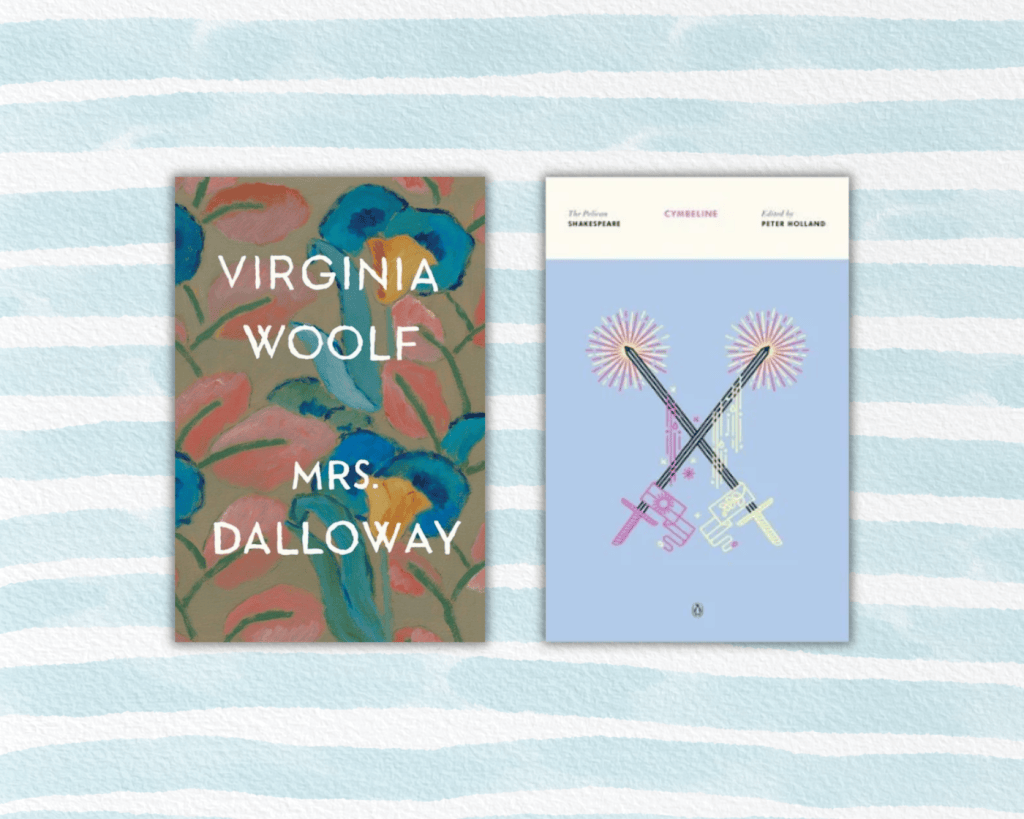
Shakespeare’s Cymbeline has several parallels with Mrs. Dalloway by Virginia Woolf. After closely reading both works, I can see why Virginia Woolf wove this particular play by Shakespeare into Mrs. Dalloway in such a preeminent way.
Cymbeline appears in Mrs. Dalloway by Virginia Woolf at the very beginning when Clarissa Dalloway is walking around London to get flowers for her party. On her way, she stops outside Hatchards bookshop and peers into the store where Cymbeline by William Shakespeare happens to be open and on display in the shop window. She reads two lines from the play. The first line she reads, “Fear no more the heat o’ the sun,” becomes a major refrain in the novel that’s repeated five times.
Fear no more the heat o’ the sun,
Nor the furious winter’s rages;
The lines read during this window-shopping moment are the first two lines of a song that King Cymbeline’s sons sing over the death of their stepbrother Cloten. The song is about how the dead feel peace and are free from the turmoil of life.
Death is a major theme in Mrs. Dalloway, and the fact that the first line of this Shakespearean dirge is repeated five times strikes me as very deliberate for two reasons. One, the lines connect Clarissa and Septimus. Clarissa says them four times, including when she is processing the news of Septimus’ death. Septimus says them once, shortly before he dies. Secondly, five is an important number in the play and in Mrs. Dalloway. There are five acts in Cymbeline, like most of Shakespeare’s plays, and there are many other examples of fives in Mrs. Dalloway, like how the main characters are all in their fifth decade of life; how Peter has spent the last five years in India and has just returned to London, how Septimus and Lucrezia have been married for five years, and how, in what might be considered the novel’s 5th act, Sally reappears at 55 years old and reveals that she has five sons.
(1) A Woman’s Choice About Who She Marries Affects the Whole Plot of The Play and The Novel
Cymbeline is a whole play is about Imogen having two choices for a husband, either her royal stepbrother Cloten or the educated but common born man named Posthumous. Imogen’s situation is quite similar to Clarissa’s. She has a choice between Peter Walsh and Richard Dalloway. Imogen chooses Poshumous, Clarissa chooses Richard. Their suitor decision drives the plots of both stories.
(2) Post War Setting for The Play & The Novel
Cymbeline is set around a devastating international war when the Roman Empire conquered ancient Britain in the first century. Mrs. Dalloway is also set around WWI’s aftermath. Of note, Britain’s positions of power are diametrically different between the two stories. In Cymbeline, the ancient British are the conquered. They are part of the Roman Empire, not at the height of their own modern day imperial power like in Mrs. Dalloway. Thematically, if you are interested in the novel’s themes of empire and power, you can read more about that in the The Novel Tea Newsletter’s Mrs. Dalloway Guide on Substack or on their podcast episode about the novel.1
(3) Lost Sons, Lost Heirs Theme
Another link in between Cymbeline and Mrs. Dalloway is a “Missing Sons/Missing Heirs Theme.” In the play, King Cymbeline’s two male heirs are kidnapped, raised in a cave, and found 20 years later. With no male heirs, his kingdom will go to his daughter and her future husband, which is why Imogen’s choice of whom to marry is so fraught and the major subject of this play.
Missing sons and disrupted lines of inheritance is part of the novel Mrs. Dalloway too because of all the lives lost during World War I. Clarissa thinks specifically of someone in her community who is grieving a life lost and an inheritance lost:
The War was over, except for some one like Mrs. Foxcroft at the Embassy last night eating her heart out because that nice boy was killed and now the old Manor House must go to a cousin.
What’s more, the lines “Fear no more the heat of the sun…” that guide Clarissa in the novel are a lament sung by Cymbeline’s sons about loss. The song reflects on the death of their stepbrother and the king’s stepson, Cloten. The message of the song is that the dead feel peace. They’re free from the turmoil of life, an idea that Clarissa ultimately takes comfort in. The song pops into her mind for the fifth and final time in the novel as she comes to terms with the news of Septimus’ death. The idea of his peace, that he doesn’t have to deal with the sun or winter’s rages anymore, helps her move forward.
“The young man had killed himself; but she did not pity him; with the clock striking the hour, one, two, three, she did not pity him, with all this going on. There! the old lady had put out her light! the whole house was dark now with this going on, she repeated, and the words came to her, Fear no more the heat of the sun.”
(4) Diamonds & Jewel Metaphors
In Cymbeline and Mrs. Dalloway, Imogen and Clarissa, respectively, are likened to (even so far as equated with value wise) diamond jewels. The diamond metaphor, for both women, inextricably has to do with the societal value of their roles as wives. Below are the select quotes from both works about these leading women as diamonds.
Diamonds in Cymbeline, Act 1, scene 4:
In Cymbeline, there is a wager between Iachamo and Posthumous about Imogen’s fidelity. The winning stakes include Posthumous’ diamond ring. Both men speak of Imogen as a jewel.
IACHAMO: As fair and as good—a kind of hand-in-hand comparison—had been something too fair and too good for any lady in Britain. If she went before others I have seen, as that diamond of yours outlusters many I have beheld, I could not believe she excelled many. But I have not seen the most precious diamond that is, nor you the lady.
IACHAMO: By the gods, it is one!—If I bring you no sufficient testimony that I have enjoyed the dearest bodily part of you mistress, my ten thousand ducats are yours; so is your diamond too. If I come off and leave her in such honor as you have trust in, she your jewel, this your jewel, and my gold are yours, provided I have your commendation for my more free entertainment.
From Mrs. Dalloway
In Mrs. Dalloway, the diamond image first comes up after Sally kisses Clarissa on the lips. Clarissa comes to think of that moment as the greatest treasure of her life, a diamond in her possession. Later, in the story, she compares the formation of her whole personality to a diamond. She hardens herself into diamond with her best facet facing out. The flawed sides of her stay hidden.
“Sally stopped; picked a flower; kissed her on the lips. The whole world might have turned upside down! The others disappeared; there she was alone with Sally. And she felt that she had been given a present, wrapped up, and told just to keep it, not to look at it—a diamond, something infinitely precious, wrapped up, which, as they walked (up and down, up and down), she uncovered, or the radiance burnt through, the revelation, the religious feeling!—when old Joseph and Peter faced them: “Star-gazing?” said Peter.” (p 35 of Mrs. Dalloway, Mariner Classics Edition)
“How many million times she had seen her face, and always with the same imperceptible contraction! She pursed her lips when she looked in the glass. It was to give her face point. That was her self?—pointed; dartlike; definite. That was her self when some effort, some call on her to be her self, drew the parts together, she alone knew how different, how incompatible and composed so for the world only into one centre, one diamond, one woman who sat in her drawing-room and made a meeting-point, a radiancy no doubt in some dull lives, a refuge for the lonely to come to, perhaps; she had helped young people, who were grateful to her; had tried to be the same always, never showing a sign of all the other sides of her—faults, jealousies, vanities, suspicions, like this of Lady Bruton not asking her to lunch; which, she thought (combing her hair finally), is utterly base! Now, where was her dress?” (p 37 of Mrs. Dalloway, Mariner Classics Edition)
“Strange, she thought, pausing on the landing, and assembling that diamond shape, that single person, strange how a mistress knows the very moment, the very temper of her house!” (p 38 of Mrs. Dalloway, Mariner Classics Edition)
Side Note: Iachamo is a sexual predator. So is Hugh Whitbread (who vengefully and forcefully kissed Sally at Bourton.) Both men also have plot points with acquiring women’s jewelry. Hugh’s jewelry moment is when Richard is disgusted with him for stopping to buy jewelry for his wife after Lady Bruton’s luncheon.
(5) Movement Between London & Italian Cities
In the play, Posthumous gets married in Lud’s Town (aka London) and flees to Rome to escape Cymbeline’s wrath. In the novel, Septimus marries Lucrezia in Milan, and they both move to London. The directions are inverted, but the character movement between London and an Italian city exists in both stories, and both movements are spurred by marriages.
Annotation Project: Mark Every Time Shakespeare’s Cymbeline Appears in Mrs. Dalloway by Virginia Woolf
Below is the complete list of the five times Cymbeline appears in Mrs. Dalloway. The page numbers correspond to the Mariner Classics edition of Mrs. Dalloway. I have a copy of this edition listed on my Bookshop.org affiliate page. If you purchase a copy using my link, your purchase supports both my blog and independent bookstores!
FIRST DIRECT MENTION – TAB 1 of 5
But what was she dreaming as she looked into Hatchards’ shop window? What was she trying to recover? What image of white dawn in the country, as she read in the book spread open:
Fear no more the heat o’ the sun,
Nor the furious winter’s rages;
p 9, Mrs. Dalloway by Virginia Woolf, Mariner Classics Edition
SECOND DIRECT MENTION- TAB 2 of 5
“Fear no more,” said Clarissa. Fear no more the heat o’ the sun; for the shock of Lady Bruton asking Richard to lunch without her made the moment in which she had stood shiver, as a plant on the river-bed feels the shock of a passing oar and shivers: so she rocked: so she shivered.
p 30, Mrs. Dalloway by Virginia Woolf, Mariner Classics Edition
THIRD DIRECT MENTION- TAB 3 of 5
Fear no more, says the heart. Fear no more, says the heart, committing its burden to some sea, which sighs collectively for all sorrows, and renews, begins, collects, lets fall.
p 39 Mrs. Dalloway by Virginia Woolf, Mariner Classics Edition
FOURTH DIRECT MENTION- TAB 4 of 5
Fear no more, says the heart in the body; fear no more.
p 139 Mrs. Dalloway by Virginia Woolf, Mariner Classics Edition
FIFTH DIRECT MENTION- TAB 5 of 5
There! the old lady had put out her light! the whole house was dark now with this going on, she repeated, and the words came to her, Fear no more the heat of the sun.
p 186 Mrs. Dalloway by Virginia Woolf, Mariner Classics Edition
This post contains affiliate links to my Bookshop.org page. You can support my blog by purchasing copies of the books I mention using my links.
Mrs. Dalloway Adaptation News!
A new screen adaptation of Mrs. Dalloway is coming on out December 11 to select theaters in New York and Los Angeles. It is called Clarissa. A wider release is scheduled for January 2027. It looks incredible!
- Thank you to Ariana, who writes the newsletter Invisible to Whom on Subtack for pointing this guide out to me and letting me know about the adaptation! ↩︎

