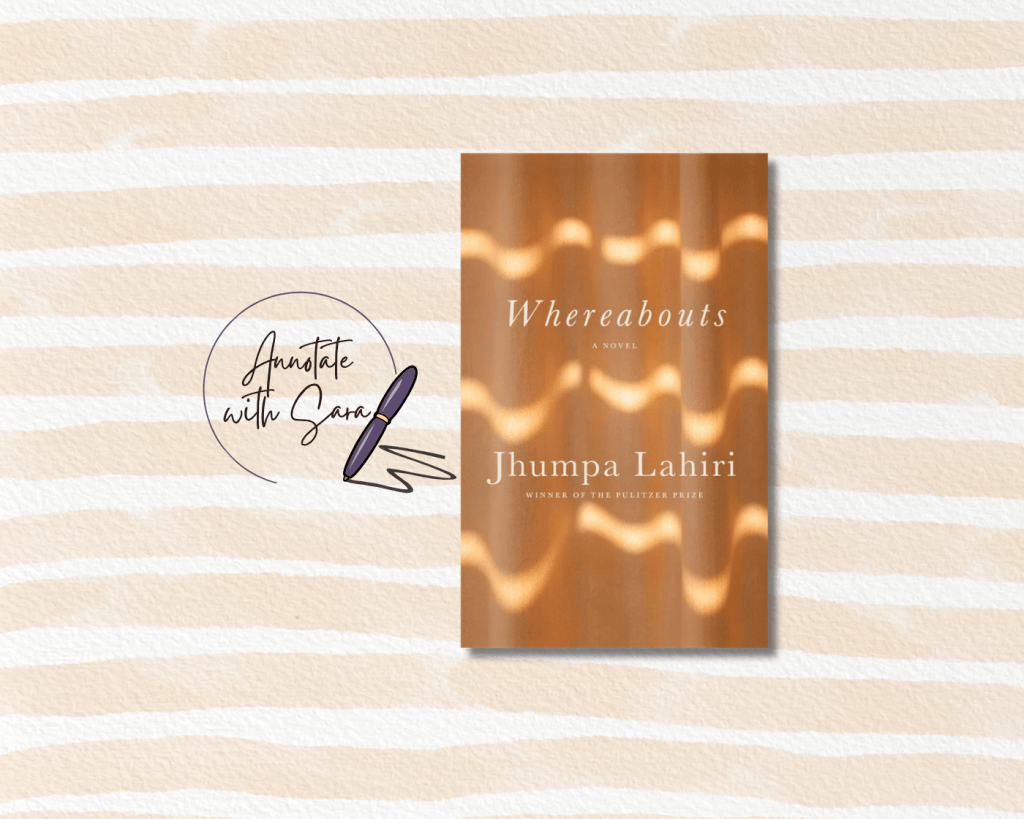
I learned that some of the greats, like Toni Morrison, embed reading cues into their work from Namwali Serpell. In her brilliant essay collection On Morrison, she explains that Toni “Morrison’s novels always teach us how to read them——and, if we pay attention, how to write our own.”1 Reading instructions hidden in plain sight in the books? Amazing. Serpell’s ensuing text evidence and contagious conviction becomes a masterclass on reading Morrison. She showed me a new way to read.
It’s been months since I finished Serpell’s On Morrison, but the book seeps into my reading life all the time. It affects how I read now. With Whereabouts by Jhumpa Lahiri, for example, I immediately began wondering:
- Is Whereabouts written in the Morrisonian2 way?
- Is it a novel that teaches its readers how to read it with clues embedded inside it?
- If so, what are the instructions Lahiri left us in Whereabouts, and where are they located?
With these questions in mind, I approached Whereabouts with a mission to find the instructions. Whereabouts is a slim, plotless novel with a unique origin story. Lahiri wrote the novel in Italian first and translated it into English. It is about an unnamed woman in academia living somewhere in Italy in a city who has chosen a life of solitude (no marriage, no kids). Written in the first person, the narrator is generous with details about her life, giving the reader clear-eyed glimpses of how her choices have panned out. This is done in 46 short vignettes that meander around the narrator’s daily life. The chapters are mostly just one or two pages and cover one mundane event: a walk, getting a coffee, a habit, a routine, an encounter with a friend, running into an ex, or observing a stranger at a museum. For very nosy people, and people watchers, this book is a delight.
A Series of Shadows to Observe Or A Series of Stumps to Leap Across
The two ways this novel explains itself —— or how to read itself —— occurs in the second chapter, the one called “On the Street,” and in the thirty-sixth chapter, the one called “In My Head.”
In “On the Street,” the narrator and a friend watch a procession of pedestrian shadows from a bridge. The light has to be just right to create this phenomenon where walking people are separated from their walking shadows. The shadows get projected far away onto a wall. The narrator and her friend wonder at this “spectacle” and lament how uncapturable it is with a camera. Ironically, though, the narrator is capturing the “spectacle” perfectly with words, so it is quite capturable. That irony was my clue that this scene could be read as instructions for how to read Whereabouts. It led me down this rabbit hole of thinking: the chapters are pretty shadowy. By that I mean, they’re mysterious, fleeting, a little eerie, and little intangible. Does the mean that all the chapters are meant to be read as a procession of shadows, like the ones the narrator is watching in “On the Street”? What if this book is spectacle that you have to be in the right place at the right time to observe? Out of all the books in the world, I happened to be reader choosing this book, putting myself in the perfect time and place to experience the spectacle of these 46 shadowy vignettes that comprise Whereabouts. They’re not captured with a camera. Instead they’re captured in Filosfia typeface, printed in this book, and as I read each one, I participate in a metaphor for reading. I’m on the bridge watching the shadows from the narrator’s proceed from page 1 to page 157.
Another way to look at each chapter is as a tree stump, each one a round, flat, and temporary place to briefly land on and quickly leap from. This imagery comes from a stump-jumping game the narrator did not like, but forced herself to play anyway with her childhood friends. She describes it in the chapter called “In My Head.” The constant leaping from stump to stump forced her to face her intense childhood fear of falling. She was just as scared of being left behind, so the narrator jumped anyway and played. Forcing herself to play, she discovered she “was tenacious as [she] was timid.”3 The stump game, and the emotions infused infused in it, are a perfect metaphor for reading Whereabouts. Reading this books requires a faith in the author and a willingness to go along with the author, despite discomfort and fear. To read, you have to decide to keep moving from chapter to chapter. You have to have some tenacity to get to the end and to face the danger of being inside a narrator’s head. That’s not without risk. Who knows what disturbing grief- or regret-filled places her mind is going to go! In the end, it’s not something that’s too hard or dangerous to do. Jumping from stump to stump or reading chapters is relatively safe. The fear is greater than the physical risk.
The narrator returns to the stump game twice in the novel. This return and repetition was my clue that the stump jumping could be a metaphor for the reading experience of Whereabouts. The stump imagery appears for a second time in “At My Mother’s” and a third time in “At the Crypt,” both times with a specific focus on the abyss between the stumps that she likens to the abyss between her parents. I really like where all this imagery lands: how dead trees become a place of play for young kids, which makes me think (a little sadly) about how dead trees became the book in my hand where my mind plays. I like to think about how the exposed life rings in the wood support the landing of little feet and in turn, how this book is full of life rings of the narrator that are supporting me intellectually, expanding my mind, and challenging me emotionally. It feels poignant that the short space between the stumps is what the narrator focused on the most, that falling was her greatest fear. As a reader, these short chapters force me to stop, cross an abyss, and start over with a new chapter 46 times. That’s a lot of free space to think. I have to do a lot of intellectual leaping to make this book work for me. The free space is unnerving. No one is holding my hand telling me how to interpret this bool. I could get lost and not get it.
This novel, in many ways, is about the gaps and abysses in a life. It’s why the distant procession of shadows and the stump-leaping works as a metaphor (or instruction) for reading this book. Sometimes, the reader has a bridge to stand on or a stump, but always, since the chapters are so short, it’s only for a moment. Like I said earlier, the reader has to jump to a new chapter or see a new shadow emerge in the procession a lot: 46 times in 157 pages. But the reader doesn’t do it alone. Even though this novel is about a woman’s solitude, she’s not alone on the bridge or when she jumps the stumps. In both cases, she is with a friend or friends. As a reader, I’m not alone either. I’m with the author. She’s on the bridge with me. She’s on the stumps with me. I am in this book with her. Also, I take comfort in how this novel has 7,243 reviews on The Storygraph right now. Reading is solitary, yes, but it does not have to be lonesome. Thousands of other people have held this book just like I did. We are companions in that way.
A Final Note On The Narrator, Some Things I Want to Mention
The narrator’s vignettes start out whimsically detached. They’re gentle and beautifully melancholic snapshots of her life. It’s pretty pleasant to be coasting inside this narrator’s private headspace in the beginning. While that gentle and interesting melancholic voice never wanes, her harsh side breaks through in later chapters. She is kind of cantankerous and super unlucky in love. She has lots of jaded thoughts about men, which are entertaining. Her judgments of younger women, however, didn’t sit well with me, but I did appreciate that she thoughtfully examines her derision of younger women and thinks through it on the page. For the most part, all her icky thoughts are kept private. To my relief, the narrator keeps inside thoughts (and the problematic fantasies she indulges in) mostly inside where they are not harming people. The thing I was most put off by was her very unexamined fatphobic opinions. These appear just a few times.
Two Reviews I Enjoyed About Whereabouts
- This is a great overview of the novel and its high and low points by Heller McAlpin for NPR called “Jhumpa Lahiri’s New ‘Whereabouts’ Is About Places Both Geographical And Emotional” from April 29, 2021.
- I love how Helena Roy contextualizes Whereabouts as Lahiri’s Covid novel and talks about against the backdrop of her other works. It’s called “Expert Isolation: Reading Jhumpa Lahiri’s Whereabouts” from May 16, 2021.
Looking for a copy of Whereabouts or On Morrison? Check out my affiliate page on Bookshop.org!
- from On Morrison by Namwali Serpell in “Chapter 1: Nobody Knows the Bluest Eye” ↩︎
- I am borrowing this word from Phillip B. Williams. I don’t know if he coined it, but he introduced me to it. It is the title of a poem in his most recent poetry collection Lift Every Voice, which I’ve wrote about previously on this blog. ↩︎
- p 125 of Whereabouts (hardcover edition) ↩︎

